
 May-18-2026
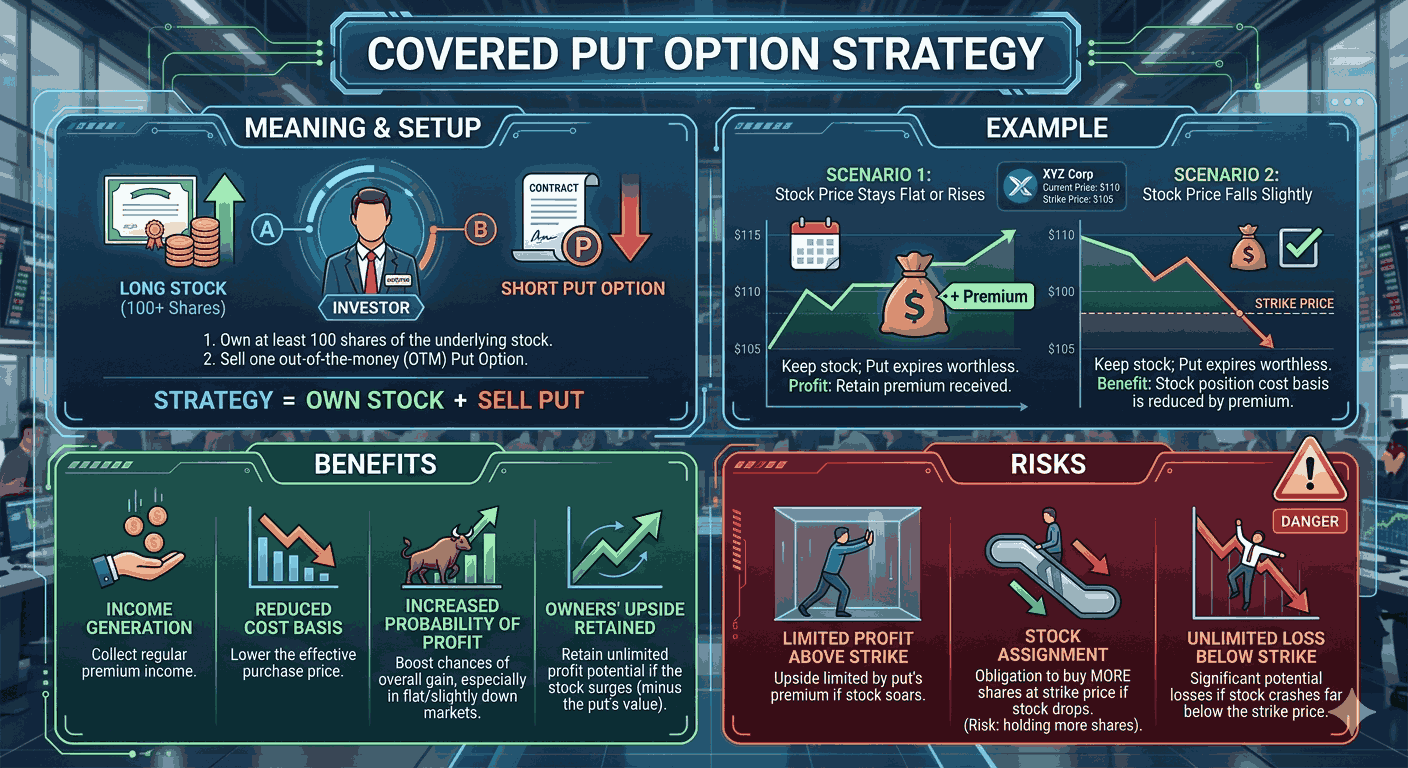
A covered put is an options trading strategy generally used when a trader has a bearish view on a stock. In this strategy, the trader holds a short position in the stock and also sells a put option on the same stock.
The objective is to earn premium income while expecting the stock price to fall or remain weak. However, this strategy carries high risk because short selling can lead to unlimited losses if the stock price rises sharply.
A covered put is created by:
By selling the put option, the trader receives a premium. This premium helps reduce the loss if the stock price rises slightly. But profit is capped because the trader has already fixed the buying-back level through the put strike price.
Angel One also explains that a covered put involves selling a put option after shorting the stock, making it a bearish strategy.
Assume a trader shorts a stock at ₹500 and sells a put option with a strike price of ₹450 for a premium of ₹20.
The trader gains from the short stock position and keeps the premium.
Profit = Short price – Strike price + Premium
Profit = ₹500 – ₹450 + ₹20 = ₹70 per share
There may be no major gain or loss from the short stock position, but the trader keeps the premium.
Profit = ₹20 per share
The short stock position starts making losses. The received premium reduces the loss, but risk remains high.
A covered put may be used when:
The trader expects the stock price to fall moderately.
The trader already has a short position.
The trader wants to earn option premium.
The trader believes downside is limited but bearishness remains.
This strategy is not ideal for beginners because short selling and options selling both require strong risk management.
Premium income: The trader earns upfront premium by selling the put option.
Works in bearish markets: It is suitable when the view is negative on the stock.
Partial loss cushion: Premium received can reduce some loss if the stock moves against the trader.
Defined profit zone: The trader can estimate maximum profit if the stock falls to or below the strike price.
Unlimited upside risk: If the stock price rises sharply, short position losses can be unlimited.
Limited profit: Maximum profit is capped.
Margin requirement: Short selling and option selling require sufficient margin.
Not beginner-friendly: It needs proper market understanding and risk control.
| Point | Covered Put | Covered Call |
|---|---|---|
| Market View | Bearish | Bullish to neutral |
| Stock Position | Short stock | Long stock |
| Option Position | Sell put | Sell call |
| Profit Potential | Limited | Limited |
| Major Risk | Stock price rises | Stock price falls |
A covered put option strategy is a bearish options strategy where a trader shorts a stock and sells a put option on the same stock. It can generate premium income and work well in a weak market, but the risk is significant because losses can rise sharply if the stock moves upward.
For AGS readers, the key takeaway is simple: use covered puts only with proper risk management, margin planning, and clear exit levels.
A covered put is an options strategy where a trader shorts a stock and sells a put option on the same stock.
Covered put is a bearish strategy because it is used when the trader expects the stock price to fall.
Maximum profit is usually the difference between the short selling price and put strike price, plus the premium received.
The biggest risk is unlimited loss if the stock price rises sharply after the trader has shorted the stock.
No. Covered put is better suited for experienced traders because it involves short selling, options selling, and margin risk.
In a covered put, the trader already has a short position in the stock. In a naked put, the trader sells a put without holding a short position.