
preloader icon
Stock Options Explained: A Complete Beginner’s Guide to Options Trading in India

Stock Options Explained: A Complete Beginner’s Guide to Options Trading in India

  • date-icon May-04-2026

What Are Stock Options?

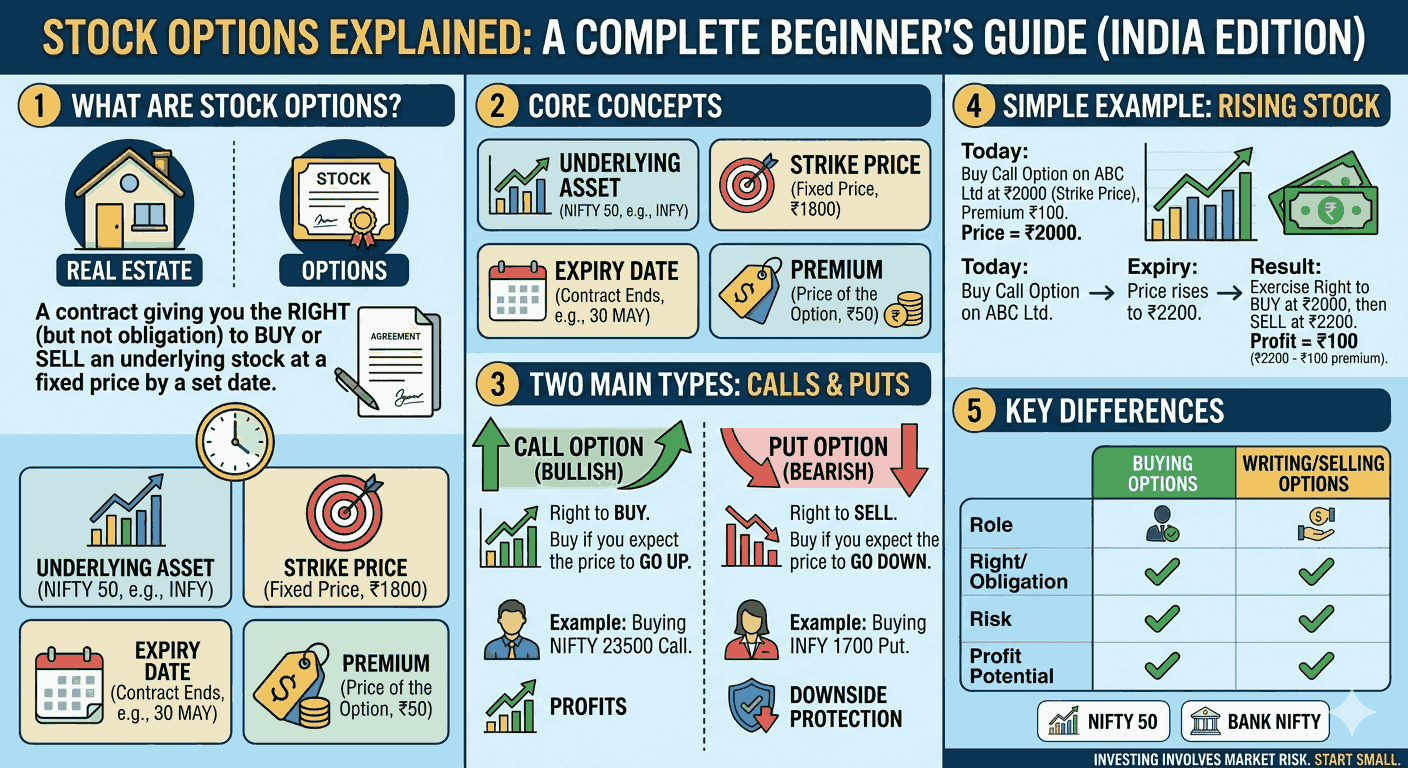
Stock options are financial contracts that give traders the right (not obligation) to buy or sell a stock at a predetermined price within a specific time frame.

In India, stock options are actively traded on exchanges like the National Stock Exchange (NSE) and Bombay Stock Exchange (BSE).

 Think of it like this:
You’re locking a price today for a stock you may want to trade later.


Types of Stock Options

1. Call Option 📈

A call option gives you the right to buy a stock at a fixed price.

  • You use this when you expect the stock price to go UP
  • Example: Buy call option of Reliance at ₹2500 → price goes ₹2700 → profit

2. Put Option 📉

A put option gives you the right to sell a stock at a fixed price.

  • You use this when you expect the stock price to go DOWN
  • Example: Buy put option at ₹2500 → price falls ₹2300 → profit

Key Terms You Must Know (High SEO Value)

  • Strike Price → Pre-decided buy/sell price
  • Premium → Cost of buying the option
  • Expiry Date → Last date to exercise option
  • Lot Size → Minimum quantity traded

How Stock Options Work (Simple Breakdown)

Let’s say:

  • Stock: TCS
  • Current Price: ₹3500
  • You buy Call Option at ₹3600 (premium ₹50)

Scenario:

  • If price goes to ₹3800 → You gain
  • If price stays below ₹3600 → You lose premium only

👉 Risk is limited, but upside can be high.


Why Traders Use Stock Options

🔹 Hedging

Protect your portfolio from market crashes

🔹 Speculation

Earn profits from price movement without owning stocks

🔹 Leverage

Control larger positions with less capital


Advantages of Stock Options

✔ Low investment entry
✔ High return potential
✔ Risk management tool
✔ Flexible strategies


Risks of Options Trading

❌ Time decay (options lose value daily)
❌ High volatility risk
❌ Requires strong market knowledge


Popular Options Trading Strategies

  • Covered Call
  • Protective Put
  • Straddle
  • Iron Condor

👉 These strategies help optimise profit vs risk based on market conditions.


Who Should Trade Stock Options?

  • Active traders
  • Hedgers (portfolio protection)
  • Advanced investors

🚫 Not ideal for beginners without market understanding.


How to Start Options Trading in India

  1. Open a Demat + Trading Account
  2. Enable F&O Segment
  3. Learn basics & strategies
  4. Start with a small capital
  5. Track risk management

You can explore platforms like Angel One, Zerodha, or Upstox for execution.


SEO FAQ Section (Rich Snippet Ready)

Q1. What are stock options in simple terms?

Stock options are contracts that allow you to buy or sell stocks at a fixed price before expiry.

Q2. Is options trading profitable?

Yes, but only with proper strategy and risk management.

Q3. What is the difference between a call and a put option?

Call = buy expectation, Put = sell expectation.

Q4. Can beginners trade options?

Yes, but only after proper learning and practice.

Q5. What is expiry in options trading?

It is the last date when the option contract is valid.


Conclusion (Conversion Angle)

Stock options are a high-impact financial instrument—massive upside, but equally serious risk. If you play it smart with strategy + discipline, it becomes a strong revenue channel.


Pro Tip (Positioning for AGSSL Brand)

If you’re building this as a content funnel, plug your brokerage CTA like:

👉 “Start trading smarter with AG Shares and Securities Ltd — advanced tools, real-time insights, zero friction onboarding.”


!Font Awesome Free 6.5.1 by @fontawesome - https://fontawesome.com License - https://fontawesome.com/license/free Copyright 2024 Fonticons, Inc.