
 Apr-06-2026
Market share is a core KPI that defines how much of the total market your company controls versus competitors. It’s basically your positioning scorecard in the industry.
If you’re scaling a business or evaluating competition, this metric is non-negotiable.
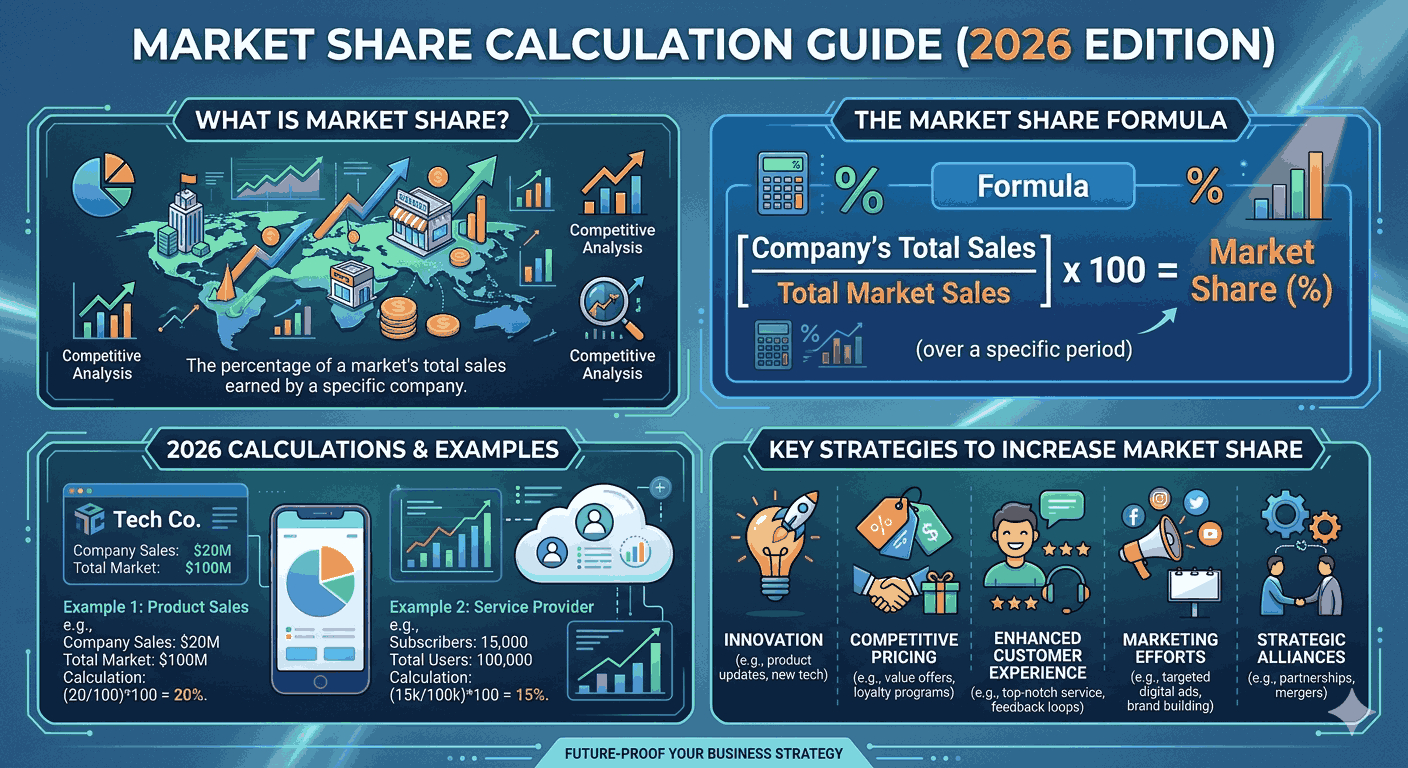
Market share represents the percentage of total industry sales captured by a company over a specific period.
Simple breakdown:
If the total market size = ₹100 crore
And your company revenue = ₹10 crore
→ Your market share = 10%
Market Share (%) = (Company Revenue / Total Market Revenue) × 100
Market Share (%) = (Units Sold by Company / Total Units Sold in Market) × 100
Let’s say:
Market Share = (5000 / 50000) × 100 = 10%
Your total share in the entire industry.
Comparison vs your biggest competitor.
Formula:
Relative Market Share = Your Share / Competitor’s Share
Straight talk—this metric drives strategy.
High market share = stronger brand authority + better margins.
Basically: execution > intention
Undercut competitors smartly—not blindly.
Offer something unique → create demand, not just compete.
Retention > acquisition (cost efficiency win)
Online + offline = wider reach
Performance marketing + analytics = scalable growth
Instead of chasing total market share, focus on:
Niche Market Share Dominance
Own a segment → expand later.
That’s how most category leaders scale.
A good market share depends on industry size, but generally 20%+ indicates strong positioning.
No, market share cannot be negative—it ranges from 0% to 100%.
Quarterly or annually for strategic insights, but high-growth companies track it monthly.
Both matter. Revenue reflects profitability, while units reflect volume dominance.
Market share isn’t just a number—it’s your competitive positioning metric.
Track it, optimise it, and align your strategy accordingly.
If you’re not measuring market share, you’re basically operating blind in a competitive market.