How to Use Open Interest for Intraday Trading
-
 Apr-20-2026
Introduction
If you’re operating in the intraday trading space, Open Interest (OI) is not optional—it’s a core data point. It gives you visibility into market participation and helps decode whether money is entering or exiting a position.
At AGS, we treat OI as a decision intelligence layer, not just a number.
What is Open Interest (OI)?
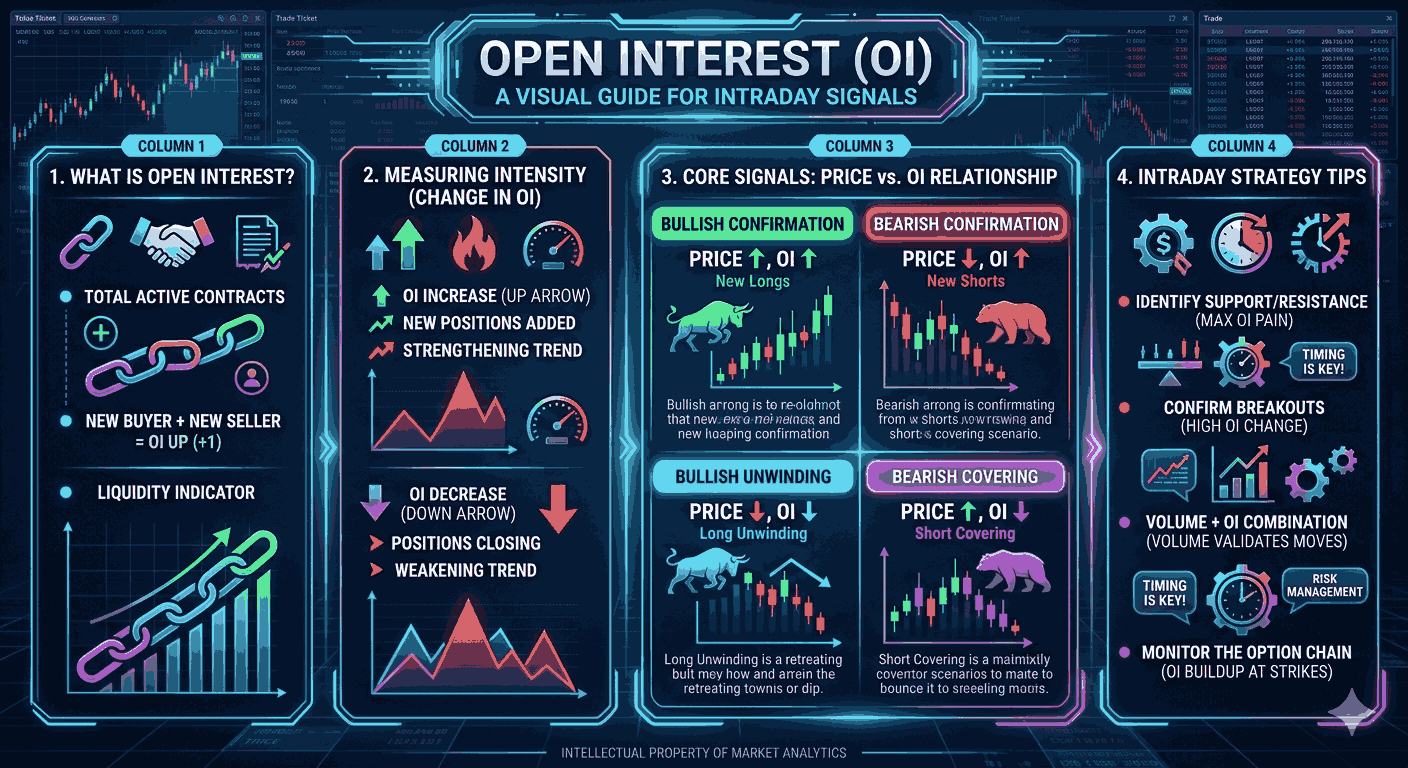
Open Interest refers to the total number of outstanding derivative contracts (futures or options) that are currently active and not yet settled.
- Increasing OI → New positions being created
- Decreasing OI → Positions being closed
Unlike volume, OI gives you commitment level, not just activity.
Why Open Interest Matters in Intraday Trading
OI helps answer critical questions:
- Is the trend backed by strong participation?
- Are traders building long or short positions?
- Is a breakout sustainable or fake?
In short: Price tells you “what,” OI tells you “why.”
How to Interpret Open Interest (Core Framework)
1. Price ↑ + OI ↑ → Strong Bullish Trend
- New money entering on the buy side
- Indicates long buildup
- High probability continuation
2. Price ↓ + OI ↑ → Strong Bearish Trend
- Traders building short positions
- Indicates short buildup
3. Price ↑ + OI ↓ → Short Covering
- Shorts exiting positions
- Rally may be temporary
4. Price ↓ + OI ↓ → Long Unwinding
- Buyers exiting
- Weakness likely to continue
Intraday Strategies Using Open Interest
1. Breakout Confirmation Strategy
- Don’t trust price breakout alone
- Confirm with rising OI
- If OI is flat → breakout may fail
2. Trend Strength Validation
- Strong trend = Price + OI moving together
- Weak trend = Price moving, OI declining
3. Reversal Signals
- Sudden drop in OI after a trend → potential reversal
- Watch for profit booking zones
4. Option Chain Analysis
- High OI at strike prices = strong support/resistance
- Helps in identifying intraday levels
Practical Example
If NIFTY is rising and OI is also increasing:
👉 Market participants are building fresh long positions
👉 Probability of continuation increases
👉 Intraday bias = Buy on dips
Pro Tips from AGS Desk
- Always combine OI with Volume + Price Action
- Avoid trading based on OI alone
- Track real-time data, not delayed feeds
- Use OI in F&O stocks and indices only
Common Mistakes to Avoid
- Misinterpreting OI without price context
- Ignoring sudden spikes (can be traps)
- Overtrading based on minor OI changes
Conclusion
Open Interest is a power tool for intraday traders. When used correctly, it helps you align with institutional money flow rather than guessing market direction.
At AGS, we recommend integrating OI into your daily trading framework to improve accuracy, timing, and confidence.
FAQs (Google Featured Snippet Optimized)
1. What is Open Interest in intraday trading?
Open Interest is the total number of active derivative contracts that are not yet closed or settled in the market.
2. How is Open Interest different from Volume?
Volume shows total trades executed, while Open Interest shows active positions still open in the market.
3. Can Open Interest predict market direction?
OI alone cannot predict direction, but when combined with price movement, it gives strong signals about trend strength.
4. What does rising Open Interest indicate?
It indicates new positions are being created, signalling strong participation.
5. Is Open Interest useful for beginners?
Yes, but beginners should use it along with price action and volume for better accuracy.
Call to Action
Want to trade smarter, not harder?
Leverage AGS insights and data-driven strategies to stay ahead in the market.