
 Dec-15-2025
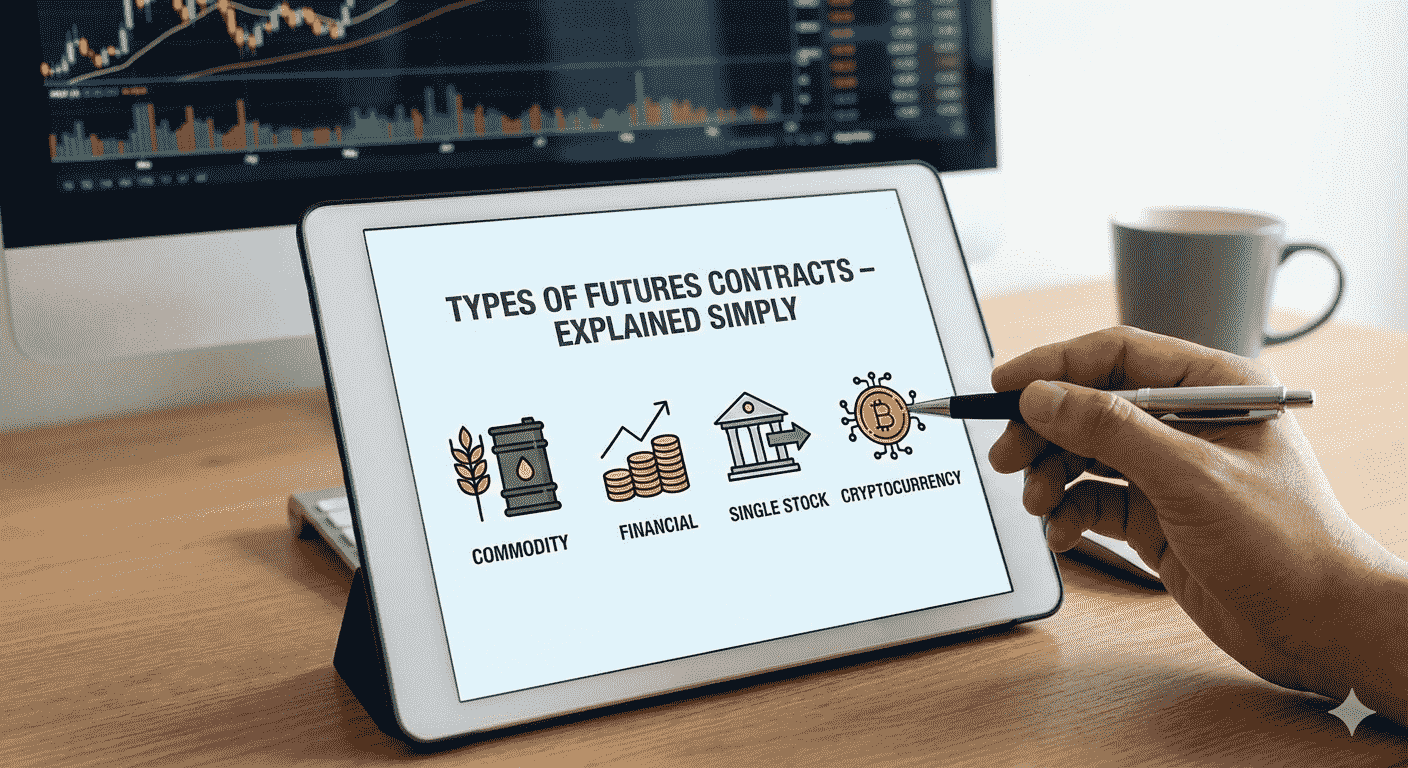
Futures contracts are standardized agreements to buy or sell an asset at a predetermined price on a future date. They’re widely used for hedging risk and leveraged trading. In India, futures trading happens on regulated exchanges like NSE and BSE.
Let’s break down the main types of futures contracts—no fluff, just fundamentals.
Commodity futures are contracts based on physical goods.
Examples:
Gold, Silver, Crude Oil, Natural Gas, Wheat, Cotton
Who uses them:
Farmers & producers → hedge price risk
Traders → speculate on price movement
Why it matters:
They help stabilize income and protect against volatility in commodity prices.
Index futures are linked to a stock market index.
Examples:
NIFTY 50, BANK NIFTY, FINNIFTY
Who uses them:
Institutional investors
Active traders & hedgers
Why it matters:
You get market-wide exposure without buying individual stocks. High liquidity, lower impact cost—big efficiency play.
Stock futures are contracts based on individual stocks.
Examples:
Reliance, TCS, HDFC Bank, Infosys
Who uses them:
Traders with directional views
Portfolio hedgers
Why it matters:
Allows leveraged exposure to a stock with lower upfront capital compared to cash market.
Currency futures track exchange rates between currency pairs.
Examples:
USD/INR, EUR/INR, GBP/INR, JPY/INR
Who uses them:
Importers & exporters
Currency traders
Why it matters:
Helps manage forex risk and protect against exchange-rate volatility.
These futures are linked to interest-bearing instruments.
Examples:
Government bonds, T-Bills
Who uses them:
Banks
Financial institutions
Why it matters:
Used to hedge against changes in interest rates impacting bond prices and borrowing costs.
Hedging against price risk
High liquidity
Leverage amplifies capital efficiency
Transparent and regulated market
Leverage can magnify losses
Mark-to-market daily settlement
High volatility requires strict risk management
Futures contracts are powerful financial instruments when used strategically. Whether you’re hedging exposure or trading trends, understanding the type of future you’re dealing with is non-negotiable. Risk first, returns next—that’s the playbook.