
 Dec-01-2025
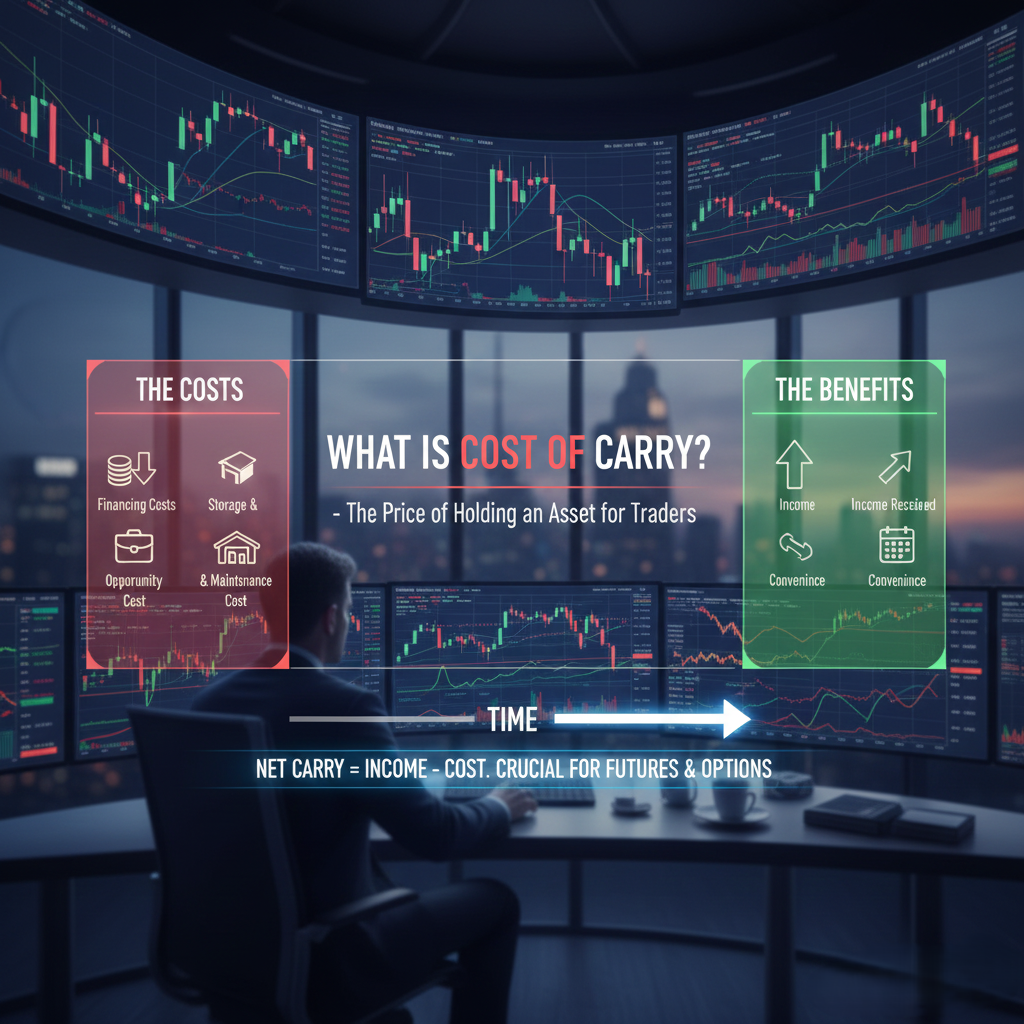
In derivatives trading, pricing isn’t random—there’s a logic engine running behind every futures contract. That engine is called Cost of Carry (CoC).
Think of it as the all-in cost of holding an asset from today until futures expiry.
If the spot is today’s “cash price,” the futures price embeds the cost (or benefit) of carrying the position for that time window. That difference forms the Cost of Carry.
Cost of Carry refers to the net cost incurred to hold an underlying asset until the expiry of its futures/forward contract.
It includes:
Financing cost (interest rate / funding cost)
Storage or insurance cost (for commodities)
Minus any benefits, like dividends or convenience yield
CoC = Extra cost you pay for not buying the asset today but holding a futures position until expiry.
Because when you commit money today (spot), you lose:
Interest you could’ve earned elsewhere
Dividends (for equity)
Cost of warehousing (for commodities)
Liquidity benefits
So the futures market adjusts pricing to reflect these factors.
That adjustment = Cost of Carry.
Cost of Carry = Futures Price – Spot Price
F = S × e^((r + s – c) × t)
Where:
F = Futures price
S = Spot price
r = Risk-free interest rate (financing cost)
s = Storage/warehousing cost
c = Convenience yield (benefit of holding asset)
t = Time until expiry (in years)
This shows how expensive it is to carry futures positions on a yearly basis.
Occurs when:
Futures Price > Spot Price
Signals:
Premium on futures
Bullish sentiment
Traders expect the asset to rise
Long buildup likely
Occurs when:
Futures Price < Spot Price
Signals:
Futures trading at discount
Bearish sentiment
Dividend impact (in equities)
Strong “reverse arbitrage”: Buy spot, sell futures
| Market Data | What It Means | Trader Mood |
|---|---|---|
| Rising CoC + Rising OI | Long buildup | Bullish |
| Falling CoC + Rising OI | Short buildup | Bearish |
| Rising CoC + Falling OI | Short covering | Bullish reversal |
| Falling CoC + Falling OI | Long unwinding | Weak / cautious |
CoC + OI is one of the most underrated data combos for F&O insight.
Exchanges and brokers use CoC to compute “fair value” of index futures.
Mispricing? Traders perform:
Cash-and-carry arbitrage
Reverse cash-and-carry arbitrage
Sudden drop in CoC often precedes:
Short buildup
Price correction
Expiry-related repositioning
Hedgers use CoC to align hedge cost vs expected returns.
Helps traders understand why futures trade at premium/discount
Acts as a sentiment indicator
Helps identify arbitrage trades
Critical for pricing models, especially in commodities and equities
Supports risk assessment for long-term futures positions
Bottom line: CoC isn’t just math—it’s a diagnostic signal for market structure.
Cost of Carry is one of those metrics that looks basic but drives the entire futures pricing engine.
Whether you’re trading, hedging, or analyzing market structure, CoC tells you:
how expensive it is to hold a position,
what the market expects, and
where traders are leaning—bullish or bearish.