

 Sep-28-2026
Successful investing is not only about finding stocks, mutual funds or other assets that can generate returns. It is equally about avoiding decisions that can unnecessarily damage a portfolio.
Investors sometimes lose money not because every investment they selected was poor, but because their overall approach lacked discipline.
Buying based on tips, taking excessive risk, reacting emotionally to market movements, frequently changing investments and concentrating too much money in a few stocks are examples of mistakes that can affect long-term results.
Recognising these mistakes early can help investors build a more disciplined investment process.
Here are some of the most common investment mistakes and practical ways to avoid them.
One of the most common mistakes is investing in a stock simply because someone recommended it.
The recommendation may come from:
Friends
Relatives
Social media
Messaging groups
Online videos
Market rumours
Unverified tips
A rising stock price can also create the impression that everyone else knows something you do not.
This can lead to buying without understanding the business.
Before investing directly in a company, an investor should ideally understand factors such as:
What does the company do?
How does it generate revenue?
Is the business profitable?
How much debt does it have?
Are profits and cash flows sustainable?
What are the major risks?
What valuation is being paid?
How does the company compare with competitors?
Research cannot guarantee a profitable investment, but it can help ensure that the decision is based on information rather than speculation.
An investment should ideally have a purpose.
For example, an investor may be saving for:
Retirement
Children's education
Buying a house
Building long-term wealth
A future business requirement
A major planned expense
Without a defined goal, it becomes difficult to determine the appropriate investment horizon, asset allocation and level of risk.
An investment suitable for a goal 15 years away may not be suitable for money required next year.
A useful investment plan therefore begins with three questions:
What is the goal?
How much money may be required?
When will the money be required?
Investors often focus heavily on potential returns while paying insufficient attention to potential losses.
Risk tolerance refers to how much investment volatility or loss an investor is financially and psychologically prepared to handle.
Consider two investors.
Investor A can comfortably remain invested even if the portfolio temporarily falls 20%.
Investor B becomes extremely uncomfortable after a 5% decline.
The same portfolio may therefore not be suitable for both investors.
Risk assessment should consider:
Income stability
Emergency savings
Financial obligations
Investment horizon
Dependents
Liquidity requirements
Ability to tolerate losses
The objective is not simply to maximise returns. It is to take a level of risk that remains consistent with your financial situation and investment goals.
Fear and greed are powerful influences in financial markets.
When markets rise rapidly, investors may become overly confident and buy simply because prices are increasing.
When markets decline sharply, the same investors may panic and sell.
This can create the opposite of a disciplined investment strategy:
Buying after prices have already risen significantly and selling after they have fallen.
Emotional decisions can also lead to:
Chasing popular stocks
Refusing to sell a poor investment
Excessive averaging
Panic selling
Overtrading
Taking excessive risk after recent profits
Having predefined investment criteria can help reduce emotional decision-making.
Investing is sometimes approached with unrealistic expectations.
An investor may expect a stock purchased today to generate substantial returns within weeks or months.
When that does not happen, the investment is sold and replaced with another supposedly better opportunity.
This creates constant portfolio switching.
Quality businesses may take years to expand earnings, strengthen market position and create shareholder value.
Similarly, diversified investment portfolios need time to experience different market cycles.
Patience does not mean holding every investment forever. It means giving a valid investment thesis sufficient time while continuing to monitor whether the underlying fundamentals remain intact.
Frequent buying and selling can create hidden performance drag.
Every transaction may involve costs such as:
Brokerage
Securities Transaction Tax
Exchange transaction charges
GST
Stamp duty
Depository-related charges where applicable
Tax consequences depending on the transaction
Suppose an investor repeatedly switches between stocks because another stock appears more attractive.
Even if individual decisions seem small, the cumulative transaction costs can reduce overall returns.
Frequent activity should not be confused with effective portfolio management.
A transaction should ideally have a clear investment rationale.
The idea sounds attractive:
Buy at the exact bottom and sell at the exact top.
In practice, consistently identifying both points is extremely difficult.
Markets react to:
Economic data
Interest rates
Corporate earnings
Foreign investment flows
Government policy
Global markets
Geopolitical events
Investor sentiment
Many of these variables change continuously.
Waiting indefinitely for the "perfect" market level may leave an investor sitting in cash while markets continue rising.
Similarly, selling everything because a correction is expected can create the problem of deciding exactly when to re-enter.
A structured investment plan can reduce dependence on perfect market timing.
Imagine investing your entire portfolio in one company.
If that company faces a serious business problem, your entire portfolio is exposed.
Now consider investing everything in several companies from the same sector.
The portfolio may contain multiple stocks but can still be highly concentrated because all the businesses may respond similarly to the same industry conditions.
Diversification involves spreading investments across appropriate:
Companies
Sectors
Asset classes
Market segments
The objective is not simply to own a large number of investments.
The objective is to avoid excessive dependence on a single source of risk.
Diversification cannot eliminate market risk, but it can reduce the impact of one individual investment performing poorly.
While insufficient diversification creates concentration risk, excessive diversification can also become problematic.
An investor may accumulate 50 or 60 stocks without having a clear reason for owning each one.
At that point:
Monitoring becomes difficult
Portfolio quality can become diluted
Strong investments may have little impact
The portfolio may begin behaving like an index without being intentionally designed that way
Effective diversification is about spreading risk intelligently rather than simply increasing the number of holdings.
Asset allocation refers to how investment capital is distributed across different asset classes.
For example, a portfolio may contain:
Equity
Debt
Gold
Cash or liquid investments
Other suitable assets
The appropriate allocation depends on financial goals, investment horizon and risk profile.
An investor with all available capital in equities may experience significant volatility during a market downturn.
Another investor holding too much cash for a long-term goal may struggle to achieve the required growth.
Asset allocation provides structure to the portfolio.
Even if a portfolio begins with an appropriate allocation, market movements can change it over time.
Suppose an investor initially decides on:
60% Equity + 40% Debt
After a strong equity market rally, the allocation may become:
75% Equity + 25% Debt
The investor is now taking more equity risk than originally intended.
Rebalancing involves periodically reviewing the portfolio and, where appropriate, bringing the allocation closer to its intended structure.
Rebalancing should be based on the investment plan rather than short-term market predictions.
Investment behaviour often changes dramatically depending on market conditions.
During a strong bull market, investors may feel:
Markets cannot fall
Risk is low
More leverage is justified
High valuations do not matter
During a severe correction, the thinking can reverse:
Markets will never recover
Equities are too risky
Everything should be sold
Both reactions can be driven more by recent price movements than by long-term financial objectives.
An investment strategy designed during calm conditions should not be abandoned casually because markets become temporarily euphoric or fearful.
A stock or mutual fund may have generated exceptional returns over the previous year.
That does not mean the same performance will continue.
Investors often buy an asset only after seeing impressive historical returns.
By that stage:
Valuation may have increased significantly
Market expectations may already be high
The business cycle may be changing
Recent performance may not be sustainable
Past performance can provide useful historical information, but it should not be the only basis for an investment decision.
Suppose an investor buys a stock at ₹500.
It falls to ₹400.
The investor buys more.
It falls to ₹300.
The investor again buys more because the average purchase price is declining.
A lower price does not automatically make an investment better.
The important question is:
Why has the price fallen?
If the company's long-term fundamentals remain strong and the valuation becomes more attractive, additional investment may have a rational basis.
But if the business is deteriorating, averaging can simply increase exposure to a poor investment.
Investors sometimes become emotionally attached to the price at which they purchased a stock.
Suppose a stock was purchased at ₹1,000 and falls to ₹650.
The investor may refuse to sell because:
"I will sell when it comes back to ₹1,000."
The market does not know or care about the investor's purchase price.
The relevant questions are:
Is the original investment thesis still valid?
Are earnings prospects intact?
Has the business changed?
Is management executing effectively?
Is there a better use for the capital?
Investment decisions should focus on future prospects rather than solely on the historical purchase price.
Herd behaviour occurs when investors make decisions primarily because many other people appear to be doing the same thing.
For example:
A stock rises rapidly.
Social media discussion increases.
More investors buy because they fear missing out.
The rising price attracts even more buyers.
This does not necessarily mean the company's underlying value has increased at the same rate.
Following the crowd without independent analysis can result in buying at inflated valuations.
A strong company is not automatically a good investment at every price.
Suppose Company A is:
Profitable
Growing rapidly
Debt-free
Well managed
These are attractive characteristics.
However, if the market price already assumes extremely high future growth, the investment may still carry significant valuation risk.
Investors should therefore distinguish between:
A good company
and
A good investment at the current price.
Valuation measures such as P/E, P/B, EV/EBITDA and cash-flow-based analysis can provide additional perspective depending on the type of business.
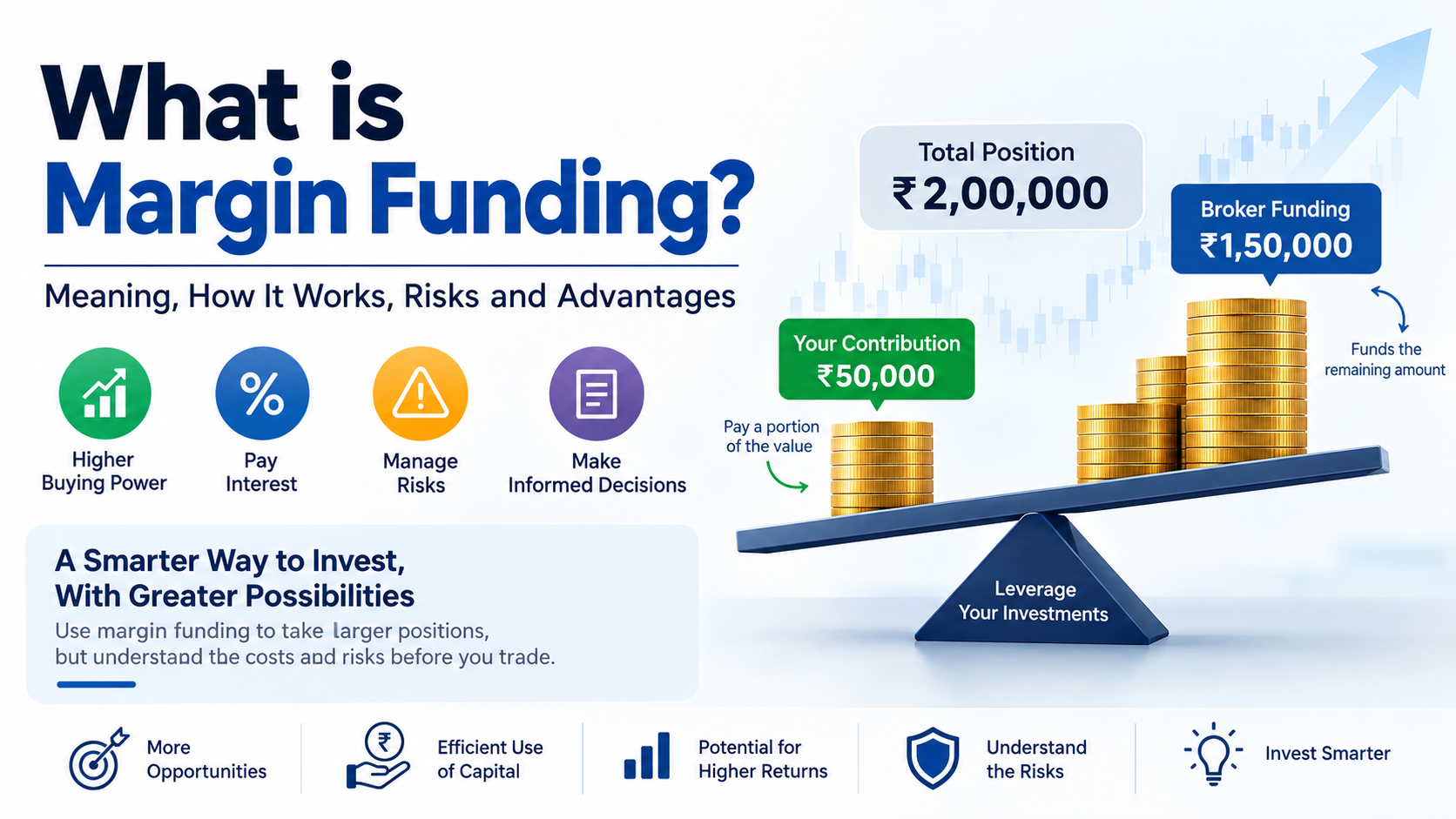
Borrowed money can magnify investment outcomes.
Suppose an investor has ₹1 lakh but takes exposure worth ₹3 lakh using leverage.
A 10% decline in the underlying position creates a ₹30,000 loss.
Relative to the investor's ₹1 lakh capital, that is a 30% loss before considering funding costs and other charges.
Leverage magnifies gains when markets move favourably, but it magnifies losses when they move against the investor.
This makes leverage one of the areas where risk management is particularly important.
Small costs can appear insignificant individually.
Over long periods, however, costs can affect compounded returns.
Investors should consider applicable:
Brokerage
Fund expense ratios
Transaction charges
Taxes
Exit loads
Advisory fees
Funding interest
Depository charges
The relevant figure is not simply gross return.
It is the return remaining after applicable costs and taxes.
Investing long-term money without maintaining adequate liquidity can create problems.
Suppose an unexpected medical expense, job disruption or family requirement occurs during a major market correction.
Without an emergency reserve, the investor may be forced to sell long-term investments at an unfavourable time.
Maintaining suitable emergency liquidity can help separate short-term financial requirements from long-term investment decisions.
| Common Mistake | Better Approach |
|---|---|
| Investing on tips | Conduct independent research |
| No financial goal | Define objective and time horizon |
| Ignoring risk | Match investments with risk capacity |
| Emotional decisions | Follow predefined investment criteria |
| Chasing quick profits | Maintain a suitable time horizon |
| Excessive trading | Transact with a clear reason |
| Timing the market | Follow a structured investment plan |
| Poor diversification | Spread risk appropriately |
| Too many holdings | Maintain purposeful diversification |
| Ignoring asset allocation | Create a target allocation |
| No rebalancing | Review the portfolio periodically |
| Chasing past returns | Evaluate future prospects and valuation |
| Blind averaging | Reassess fundamentals first |
| Excessive leverage | Keep exposure within risk capacity |
| Ignoring costs | Evaluate net returns |
A disciplined investment process does not need to be complicated.
Before investing, define:
Goal: Why are you investing?
Time Horizon: When will you need the money?
Risk: How much volatility and loss can you tolerate?
Asset Allocation: How should your capital be distributed?
Investment Criteria: What conditions must an investment meet before you buy it?
Exit Criteria: Under what circumstances will you sell?
Review Process: How frequently will the portfolio be evaluated?
Having answers to these questions can reduce impulsive decisions.
Checking stock prices every few minutes is not the same as reviewing a portfolio.
A meaningful portfolio review should focus on whether:
Financial goals have changed
Risk capacity has changed
Asset allocation has drifted
Company fundamentals have changed
Investment thesis remains valid
Portfolio concentration has increased
Costs remain reasonable
The appropriate review frequency depends on the investment strategy and products held.
The objective is to review periodically without reacting unnecessarily to every short-term market movement.
Market corrections are a normal feature of equity investing.
During a sharp decline, investors should avoid making decisions based solely on fear.
Instead, review:
Portfolio quality
Asset allocation
Liquidity requirements
Company fundamentals
Investment horizon
Original investment objectives
A falling market does not automatically mean every investment should be sold.
Similarly, a lower price does not automatically mean every stock should be purchased.
Investment decisions should continue to be based on analysis.
Strong markets create a different behavioural challenge.
Rapidly rising prices can encourage:
Excessive risk-taking
Overconfidence
Leverage
Speculative investing
Ignoring valuations
Concentrating in recent winners
Risk does not disappear simply because markets are rising.
A disciplined investor should continue to evaluate valuations, diversification and portfolio allocation even during periods of strong returns.
Before making an investment decision, ask yourself:
Do I understand what I am investing in?
What is my investment objective?
What is my expected holding period?
What can cause this investment to lose money?
How much of my portfolio will be exposed?
Am I adequately diversified?
Is the valuation reasonable?
Am I buying because of research or because the price is rising?
Can I tolerate a significant temporary decline?
What would make me sell?
What costs will I incur?
Does this investment fit my overall financial plan?
If these questions cannot be answered clearly, additional research may be needed.
Investment success is influenced not only by what investors buy but also by how they behave after investing.
Some of the most damaging investment mistakes are surprisingly simple: investing without research, taking more risk than you can handle, chasing recent winners, reacting emotionally to market movements, trading excessively and failing to diversify.
Avoiding these mistakes does not guarantee profits. Markets will always involve uncertainty and risk.
However, a structured process can improve decision-making.
Set clear financial goals, understand the investments you own, diversify appropriately, keep costs under control and review your portfolio periodically.
Most importantly, avoid allowing short-term market excitement or fear to replace a well-considered long-term investment strategy.
Common mistakes include investing without research, ignoring risk tolerance, poor diversification, emotional decision-making, excessive trading, market timing and chasing past performance.
A tip may not consider the company's fundamentals, valuation, your financial goals or your risk profile. Decisions based solely on unverified information can therefore expose investors to unnecessary risk.
Consistently identifying market tops and bottoms is extremely difficult. Many investors instead use structured investment and asset-allocation strategies that do not depend on predicting every short-term market movement.
Diversification spreads investment exposure across different securities, sectors or asset classes, reducing dependence on the performance of a single investment.
Yes. Holding too many investments without a clear purpose can make the portfolio difficult to monitor and dilute the impact of high-conviction holdings.
Fear, greed and overconfidence can cause investors to buy after large price increases, sell during panic or take risks inconsistent with their original financial plan.
There is no universal schedule. Portfolios should be reviewed periodically and when significant changes occur in financial goals, risk capacity or the fundamentals of major investments.
No. Additional investment should depend on the company's fundamentals, valuation and investment thesis rather than simply because its share price has fallen.
Frequent transactions can increase brokerage, taxes and other costs while encouraging investors to react to short-term market movements.
The appropriate decision depends on the investor's goals, liquidity needs, asset allocation and the fundamentals of the investments held. A market decline alone should not replace fundamental analysis.
Asset allocation helps distribute capital across asset classes according to financial goals, time horizon and risk tolerance.
Investing in products or securities without understanding how they work, what risks they carry and how they fit into the investor's overall financial plan is one of the most important mistakes to avoid.
What are the most common investment mistakes?
What investment mistakes should beginners avoid?
Why is investing based on stock tips risky?
Why should investors avoid trying to time the market?
How does diversification reduce investment risk?
How can emotional investing affect returns?
Is frequent buying and selling bad for investors?
Why is portfolio rebalancing important?
Is averaging down a good investment strategy?
How can investors avoid common investment mistakes?