
 Sep-21-2026
Investors sometimes identify an investment opportunity but may not have enough funds available to purchase the desired quantity of shares. Margin funding, commonly offered through a Margin Trading Facility (MTF), allows eligible investors to purchase approved securities by contributing only a portion of the transaction value while the broker funds the remaining amount.
In simple terms, margin funding allows you to take a larger market position than you could purchase using only your available cash.
However, the additional buying power comes with additional risk. The funded amount generally attracts interest, and a decline in the value of the purchased securities may require the investor to provide additional margin or face liquidation of the position.
Understanding both sides of margin funding is therefore essential before using leverage.
Margin Trading Facility is a facility through which an eligible investor can purchase approved shares by paying a prescribed margin instead of the entire transaction value upfront.
The remaining amount is funded by the broker, subject to applicable regulations, broker policies and margin requirements.
The shares purchased under MTF generally serve as collateral against the funded amount and are subject to the prescribed pledge mechanism.
The investor pays interest on the amount funded by the broker for the period during which the facility is used.
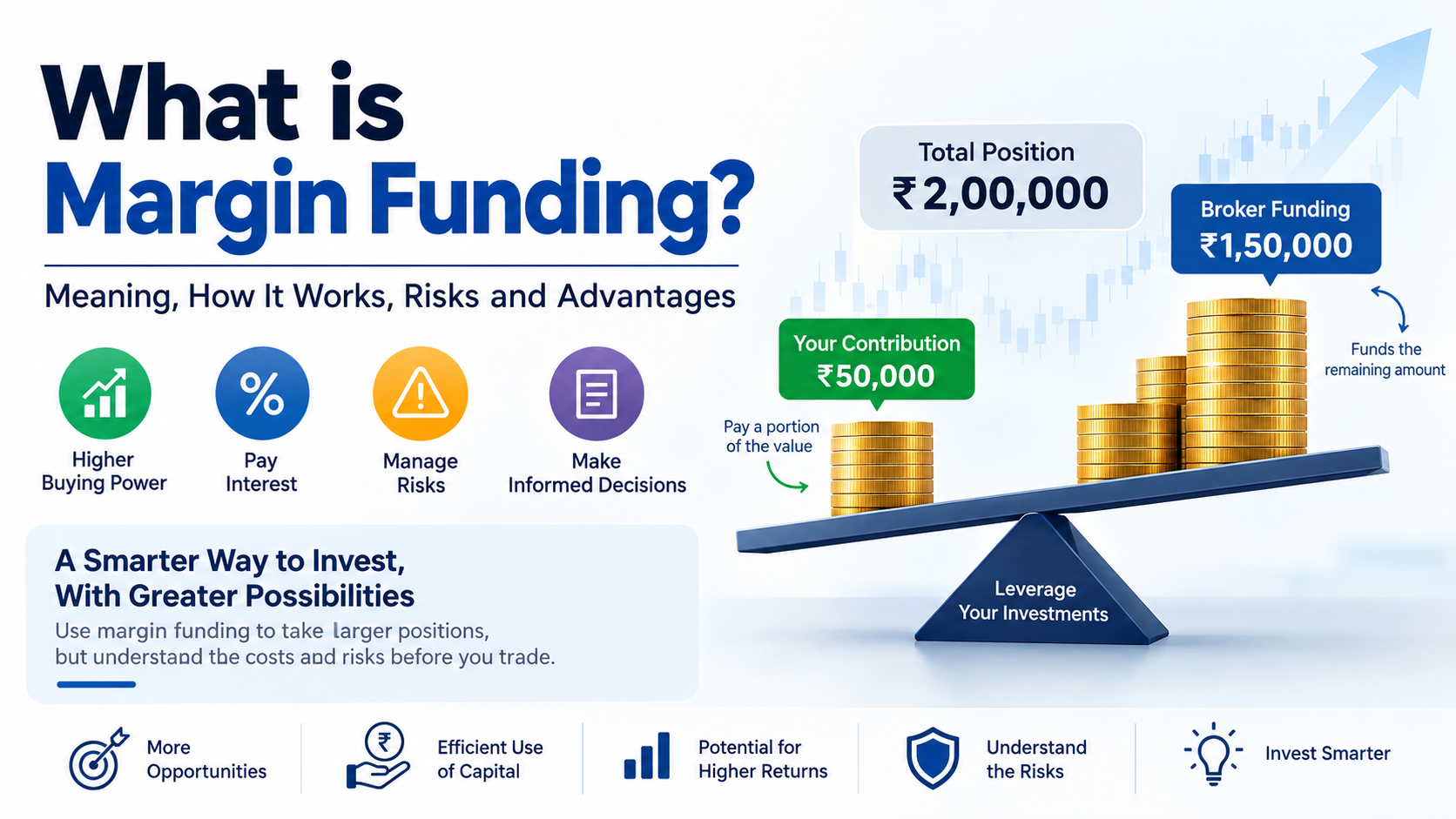
Suppose you want to purchase shares worth ₹2,00,000.
Assume, purely for illustration, that the applicable arrangement requires you to contribute ₹50,000 and the broker funds ₹1,50,000.
Your contribution:
₹50,000
Broker-funded amount:
₹1,50,000
Total position:
₹2,00,000
You now have exposure to shares worth ₹2 lakh even though you initially contributed only ₹50,000.
This is called leverage.
If the shares rise in value, the gain is calculated on the entire position.
If the shares fall, however, the loss is also calculated on the entire position.
That is the central feature—and risk—of margin funding.
Suppose an investor buys 1,000 shares at ₹200 each.
Total purchase value:
1,000 × ₹200 = ₹2,00,000
Assume the investor contributes ₹80,000 and the broker funds the remaining ₹1,20,000.
Now suppose the share price rises from ₹200 to ₹220.
New market value:
1,000 × ₹220 = ₹2,20,000
Gross gain:
₹2,20,000 − ₹2,00,000 = ₹20,000
The investor has earned a gross market gain of ₹20,000 on an initial contribution of ₹80,000.
However, this is not the final return.
Interest on the ₹1,20,000 funded amount, brokerage, statutory charges, taxes and other applicable costs must be deducted.
Leverage works in both directions.
Using the same example:
Purchase price: ₹200
Quantity: 1,000 shares
Position value: ₹2,00,000
Investor contribution: ₹80,000
Broker funding: ₹1,20,000
Suppose the share price falls to ₹180.
New market value:
₹180 × 1,000 = ₹1,80,000
Market loss:
₹20,000
The ₹20,000 loss is significant relative to the investor's ₹80,000 contribution.
This illustrates why percentage losses on the investor's own capital can be much larger than the percentage decline in the underlying share.
Leverage means controlling a larger investment using a smaller amount of your own capital.
Suppose:
Your capital = ₹1 lakh
Total MTF position = ₹4 lakh
Your market exposure is four times your contributed capital in this simplified example.
If the portfolio moves 5%:
5% of ₹4 lakh = ₹20,000
Relative to your ₹1 lakh contribution, this represents a 20% movement before considering funding costs and other charges.
This is why leverage should be used carefully.
Margin is the amount that the investor must contribute and maintain against an MTF position.
The required margin depends on factors such as:
Applicable regulatory framework
Security being purchased
Risk characteristics
Broker's risk-management policy
Market conditions
Not every stock is necessarily eligible for MTF.
The required margin can also differ across eligible securities.
Suppose shares purchased through MTF decline significantly.
As their market value falls, the investor's available margin may become insufficient relative to the required level.
The broker may then ask the investor to provide additional funds or eligible collateral.
This is commonly referred to as a margin call.
If the required margin is not provided within the applicable timeline, the broker may take action under its risk-management policy, which can include liquidating some or all of the position.
This can result in losses being realised even if the investor originally intended to hold the shares for longer.
Margin funding is borrowing, so the funded amount generally attracts interest.
Suppose:
Broker-funded amount = ₹2,00,000
Illustrative annual interest rate = 15%
Holding period = 30 days
Approximate interest:
₹2,00,000 × 15% × 30 ÷ 365
= approximately ₹2,466
This amount reduces the investor's net return.
Actual interest rates and calculation methods vary among brokers and may change. Investors should therefore review the broker's latest tariff sheet and MTF terms before using the facility.
Funding costs accumulate with time.
Suppose an investment generates a 7% gain over several months, but a substantial part of that return is consumed by MTF interest and transaction costs.
The trade may look profitable based on share-price movement while producing a much smaller net return after financing costs.
This makes holding period an important consideration in margin-funded investing.
Margin funding allows investors to purchase a larger quantity of eligible shares without paying the entire value upfront.
This can increase market exposure using limited available capital.
An investor does not need to deploy the entire transaction value immediately.
The remaining capital may remain available for other purposes, subject to appropriate risk management.
When the market moves favourably, gains are generated on the full position rather than only on the amount contributed by the investor.
However, the same mechanism magnifies losses when prices move adversely.
An investor who expects funds to become available later may use MTF to take an eligible position earlier.
The cost of funding should still be compared with the expected benefit.
MTF allows investors to take leveraged exposure to eligible delivery positions rather than restricting leverage only to intraday trading.
The exact holding conditions depend on the applicable regulatory and broker framework.
The advantages of leverage should always be considered alongside its risks.
This is the most important risk.
A relatively small percentage decline in the share price can translate into a much larger percentage loss on the investor's own capital.
Interest continues to accrue on the funded amount according to the broker's terms.
A position therefore needs to generate sufficient returns merely to cover financing and transaction costs before producing a net profit.
A sharp fall in the security's value may create a margin shortfall.
The investor may have to deposit additional funds or collateral.
If the investor fails to maintain the required margin, the broker may liquidate the position according to applicable terms and risk policies.
This may happen during an unfavourable market period.
Margin funding does not reduce normal stock-market risk.
Company results, economic conditions, regulatory developments and unexpected news can cause share prices to fall.
Using leverage to build a large position in one or two stocks can significantly increase portfolio risk.
A stock can open substantially below its previous closing price following major news.
A sharp gap can create losses faster than an investor can add margin or exit at the intended price.
Greater buying power can encourage investors to take positions larger than they would normally consider.
Leverage can therefore magnify the financial consequences of poor investment decisions.
| Basis | Margin Funding / MTF | Normal Delivery |
|---|---|---|
| Purchase Amount | Partly funded by investor and broker | Generally paid fully by investor |
| Leverage | Yes | No funding leverage |
| Interest Cost | Applicable on funded amount | No broker funding interest |
| Margin Requirement | Must be maintained | Not applicable in the same manner |
| Margin Call Risk | Yes | Generally no MTF margin call |
| Forced Liquidation Risk | Possible under MTF terms | Lower due to absence of funding obligation |
| Profit Potential | Magnified by leverage | Based on investor's own deployed capital |
| Loss Impact | Can be magnified | Limited to unleveraged position exposure |
| Complexity | Higher | Lower |
Margin funding and intraday trading are not the same.
In intraday trading, the trader generally intends to open and close the position within the same trading session.
MTF is designed for eligible funded delivery positions that may be carried beyond the trading day, subject to applicable conditions.
| MTF | Intraday Trading |
|---|---|
| Position may be carried forward | Position generally closed the same day |
| Funding interest may apply | Funding structure differs |
| Shares are subject to applicable pledge requirements | Generally no delivery holding |
| Designed for funded delivery exposure | Designed for same-day trading |
These two facilities should also not be confused.
With MTF, funding is used specifically for purchasing eligible securities.
A Loan Against Securities generally involves pledging existing investments to obtain a loan.
The purpose, structure, interest rates, eligibility and risks can therefore differ significantly.
Margin funding may be considered by experienced investors who:
Understand leverage
Can analyse individual stocks
Have sufficient liquidity for margin calls
Understand funding costs
Can tolerate market volatility
Have a defined exit strategy
Closely monitor their positions
It may be unsuitable for investors who do not fully understand how leverage can affect losses.
A new investor should first understand ordinary cash-market investing before considering leverage.
Important concepts include:
Stock-market volatility
Position sizing
Stop loss
Fundamental analysis
Technical risk levels
Portfolio diversification
Margin requirements
Interest costs
Buying more shares simply because funding is available can increase risk significantly.
An investor should not calculate profit using only the difference between purchase and sale prices.
A more realistic calculation is:
Net Profit = Sale Value − Purchase Value − Funding Interest − Brokerage − Statutory Charges − Applicable Taxes and Other Costs
Suppose:
Gross trading profit = ₹15,000
Funding interest = ₹4,000
Brokerage and other charges = ₹1,000
Approximate net profit before considering any applicable income-tax treatment:
₹15,000 − ₹4,000 − ₹1,000 = ₹10,000
Funding cost can therefore materially change the economics of the trade.
Having access to maximum leverage does not mean it must be fully used.
Consider how much money could be lost if the share falls 5%, 10% or more.
Keep adequate funds available to deal with potential margin requirements.
Using borrowed funds in a single volatile stock can create substantial risk.
Estimate the interest cost for the expected holding period before taking the position.
Decide in advance when the investment thesis would be considered invalid.
Results, dividends, corporate actions, regulatory announcements and other developments can influence prices.
Suppose an investor has ₹1,00,000.
Investment = ₹1,00,000
If the shares rise 10%:
Gross profit = ₹10,000
Suppose the investor uses ₹1,00,000 as their contribution to obtain total exposure of ₹3,00,000.
If the shares rise 10%:
Gross market profit = ₹30,000
The leveraged position produces a larger gross gain.
However, interest and other costs must be deducted.
Now consider the opposite situation.
If the stock falls 10%:
Without leverage:
Loss = ₹10,000
With ₹3 lakh exposure:
Loss = ₹30,000
The example demonstrates the fundamental rule of margin funding:
Leverage magnifies both gains and losses.
Investors sometimes focus only on the expected share-price appreciation.
Maximum eligibility should not be confused with an appropriate risk level.
Adding further leveraged exposure to a declining stock can increase losses rapidly.
Failure to respond to a margin shortfall can result in forced liquidation.
Higher volatility can increase the probability of rapid margin erosion.
Leverage makes disciplined exits particularly important.
Before activating or using Margin Trading Facility, check:
Which stocks are eligible?
What margin must you contribute?
What is the applicable interest rate?
How is interest calculated?
What additional charges apply?
How long can the position be carried?
What happens if margin falls short?
What is the broker's liquidation policy?
What is the applicable pledge process?
How will corporate actions be handled?
Read the broker's latest MTF terms rather than relying only on headline leverage.
Margin funding itself is neither inherently good nor bad.
It is a financial tool.
Used carefully, it can provide additional buying power and capital flexibility.
Used without adequate risk management, it can amplify losses, create margin calls and force investors to exit positions at unfavourable prices.
The key question is therefore not simply whether margin funding is beneficial.
The more important question is whether the investor understands the cost and risk of leverage.
Margin funding allows investors to purchase eligible securities by contributing part of the transaction value while the broker funds the remaining amount.
Its primary advantage is increased buying power. Investors can take larger positions without deploying the full purchase value upfront.
But that advantage comes at a cost.
Interest charges reduce returns, market losses are magnified and falling prices can create additional margin requirements. In severe cases, positions may be liquidated to meet risk-management requirements.
Investors considering MTF should therefore calculate the complete position value—not just their initial contribution—and understand how much they could lose if the market moves against them.
Margin funding is most useful when leverage is treated as a carefully controlled financial tool rather than additional money available for taking bigger risks.
Margin funding is a facility in which an investor contributes part of the purchase value of eligible securities while the broker funds the remaining amount, subject to applicable terms and regulations.
MTF stands for Margin Trading Facility. It allows eligible investors to purchase approved securities by paying the required margin instead of the full transaction value upfront.
Yes. Brokers generally charge interest on the amount funded under MTF. Rates and calculation methods vary.
A margin call occurs when the available margin becomes insufficient and the investor is required to provide additional funds or eligible collateral.
The broker may liquidate some or all of the position according to applicable regulations and its risk-management policy.
Leverage is the primary risk because it magnifies losses relative to the investor's own capital.
MTF is designed to allow eligible funded positions to be carried forward, subject to broker terms, regulatory requirements and continued maintenance of the required margin.
No. MTF is generally available only for eligible securities under the applicable regulatory and broker framework.
No. Intraday positions are generally closed during the same trading session, while eligible MTF positions can be carried forward subject to applicable conditions.
Beginners should understand cash-market investing, leverage, margin calls, interest costs and risk management before considering margin funding.
It allows an investor to control a larger position using less of their own capital. A favourable price movement can therefore generate a larger return relative to the investor's contribution. The same leverage also magnifies losses.
Check eligible securities, margin requirements, funding interest, charges, holding conditions, pledge requirements and the broker's margin-shortfall and liquidation policies.
What is margin funding in the stock market?
How does Margin Trading Facility work?
What are the advantages of margin funding?
What are the risks of margin funding?
Is interest charged on MTF?
What is a margin call in MTF?
What happens if MTF margin falls short?
What is the difference between MTF and intraday trading?
Are all shares eligible for margin funding?
Is margin funding suitable for beginners?