
 Sep-14-2026
When people start investing in the stock market, one of the first decisions they face is whether to invest directly in company shares or take the mutual fund route.
Both can provide exposure to equities, but the way your money is invested is quite different.
When you buy shares directly, you decide which company to invest in, how much to invest and when to buy or sell. In an actively managed equity mutual fund, these decisions are generally handled by a professional fund manager within the scheme's stated investment objective. Passive funds, on the other hand, typically aim to track a specified index.
This difference affects diversification, control, costs, time commitment and risk.
Understanding these factors can help investors choose an approach that fits their financial goals, knowledge and risk appetite.
Equity represents ownership in a company.
When you purchase shares of a listed company, you become one of its shareholders. Your investment value then moves according to the market price of those shares.
Suppose you purchase 100 shares of a company at ₹500 each.
Your investment is:
100 × ₹500 = ₹50,000
If the share price rises to ₹600, the market value becomes:
100 × ₹600 = ₹60,000
This represents an unrealised gain of ₹10,000 until the shares are sold.
If the price falls to ₹400, the investment value becomes ₹40,000.
Direct equity therefore gives investors the opportunity to benefit from a company's growth while also exposing them directly to company-specific and market risks.
A mutual fund pools money from multiple investors and invests it according to a predefined investment objective.
Depending on the scheme, the portfolio may invest in:
An equity mutual fund primarily invests in shares of companies.
Instead of selecting each company yourself, you invest in units of the mutual fund scheme.
The value of each unit is represented by its Net Asset Value (NAV).
Suppose you invest ₹1,00,000 in a mutual fund when its NAV is ₹50.
Ignoring applicable charges for simplicity, the approximate number of units would be:
₹1,00,000 ÷ ₹50 = 2,000 units
If the NAV later increases to ₹60:
2,000 × ₹60 = ₹1,20,000
Your investment value would be ₹1,20,000.
If the NAV falls, the value of your investment will also decline.
Mutual funds are therefore market-linked investments and do not guarantee returns unless specifically structured otherwise under applicable regulations.
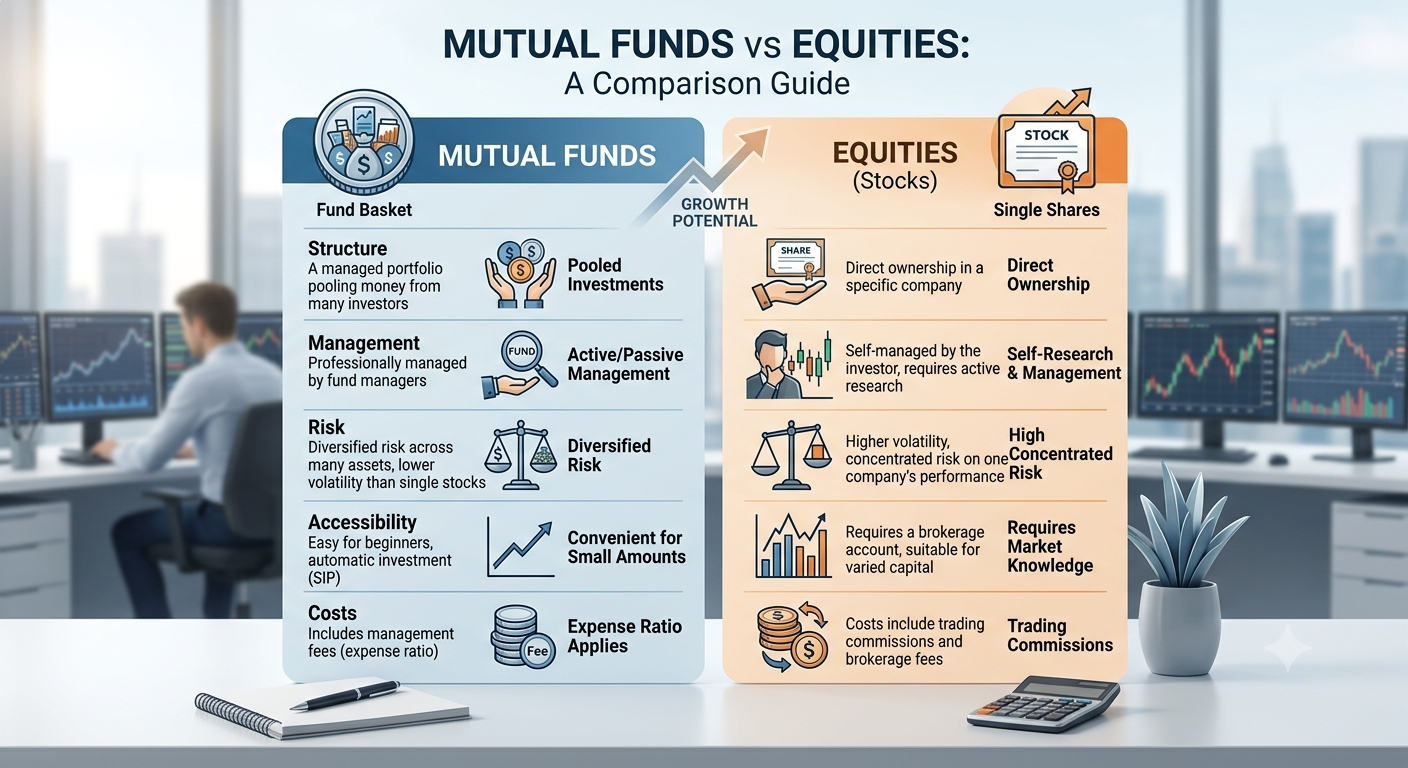
| Basis | Mutual Funds | Direct Equities |
|---|---|---|
| Investment | Units of a fund | Shares of individual companies |
| Stock Selection | Fund manager or index methodology | Investor |
| Diversification | Usually spread across several securities | Depends on investor's portfolio |
| Control | Limited | High |
| Research Required | Relatively lower | Relatively higher |
| Time Commitment | Lower | Higher |
| Company-Specific Risk | Reduced through diversification, not eliminated | Can be high |
| Return Potential | Depends on portfolio performance | Depends directly on selected stocks |
| Professional Management | Available in actively managed funds | Investor manages portfolio |
| Investment Method | Lump sum or SIP | Direct share purchases |
| Pricing | Based on applicable NAV | Market price changes during trading hours |
| Suitability | Investors seeking a structured portfolio approach | Investors comfortable selecting and monitoring stocks |
Diversification is one of the biggest differences between mutual funds and direct equity.
Suppose you have ₹50,000.
If you invest the entire amount in one company and its share price falls 30%, your portfolio may suffer a significant loss.
A diversified mutual fund may spread money across several companies and sectors.
If one company performs poorly, stronger performance elsewhere may partly offset the impact.
Diversification does not eliminate market risk, but it can reduce dependence on the performance of a single company.
Actively managed mutual funds employ professional fund managers and research teams.
They study factors such as:
Direct equity investors have to perform much of this analysis themselves or rely on professional research.
This makes direct investing potentially more demanding in terms of knowledge and time.
Direct equity offers significantly greater control.
You decide:
In a mutual fund, these portfolio-level decisions are generally determined by the scheme's mandate and fund-management process.
For investors who enjoy researching companies and constructing portfolios, direct equity may offer greater flexibility.
For investors who prefer delegating security selection, mutual funds may be more convenient.
Both mutual funds and equities carry investment risk.
However, the nature of that risk can differ.
If a large portion of your portfolio is invested in only a few companies, poor performance in one stock can have a substantial impact.
Direct equity investors face risks such as:
Mutual funds can reduce company-specific concentration through diversification, but they still remain exposed to market movements.
Their risks may include:
Mutual funds should therefore not be considered risk-free.
Direct equities can generate substantial returns when the right companies are selected at appropriate valuations and held through periods of business growth.
However, poor stock selection can also result in significant losses.
Mutual fund returns reflect the combined performance of their portfolio.
Diversification can reduce the impact of individual winners as well as individual losers.
Therefore, it is incorrect to assume that direct equity will always outperform mutual funds or that mutual funds will always provide better returns.
Performance depends on market conditions, investment choices, costs and holding period.
Direct equity investing requires ongoing research.
An investor may need to monitor:
Mutual fund investors generally spend more time selecting and reviewing the fund rather than researching every individual company in the portfolio.
This can make mutual funds more convenient for people who do not have the time or expertise to continuously track individual businesses.
Mutual funds often allow investors to start with relatively small amounts through systematic investment plans.
For example, an investor may invest a fixed amount every month through a SIP.
Direct equity investment depends on the market price of the selected shares and the number of shares purchased.
Both approaches can therefore be accessible to retail investors, but SIPs provide a particularly structured way of investing smaller amounts regularly.
One of the popular features of mutual funds is the Systematic Investment Plan (SIP).
Through a SIP, investors contribute a predetermined amount at regular intervals.
For example:
₹5,000 per month
Over one year, the investor contributes:
₹5,000 × 12 = ₹60,000
The units purchased each month depend on the prevailing NAV.
When NAV is lower, the same investment amount buys more units. When NAV is higher, it buys fewer units.
This mechanism is commonly known as rupee-cost averaging, although it does not guarantee profits or prevent losses.
Both direct equity and mutual funds involve costs.
Depending on the scheme and transaction, costs may include:
The expense ratio is reflected in the scheme's NAV.
Direct equity transactions may involve:
Investors should evaluate costs because they reduce net returns.
Listed shares can generally be bought and sold during exchange trading hours, subject to available market liquidity and applicable settlement rules.
Open-ended mutual funds generally allow investors to submit redemption requests according to scheme terms, with the applicable NAV determined under regulatory cut-off rules.
The actual receipt of redemption proceeds depends on the type of scheme and applicable settlement timelines.
Certain mutual fund products may also have lock-ins or specific redemption restrictions.
Direct equity investors can see the stocks they own and their market prices during trading hours.
Mutual funds disclose their portfolios and other scheme information according to regulatory requirements.
However, mutual fund investors do not control individual buy and sell decisions within the portfolio.
Direct equity investing can involve frequent price movements.
Seeing a stock rise or fall sharply may encourage investors to:
Mutual funds can create some distance between the investor and individual stock movements.
However, mutual fund investors can still make emotional decisions during market volatility, such as stopping SIPs or redeeming investments after a market decline.
Consider two investors, Rahul and Priya.
Rahul invests ₹1,00,000 directly in five stocks after researching the companies himself.
Priya invests ₹1,00,000 in a diversified equity mutual fund.
Rahul has greater control over his portfolio. If one of his selected stocks performs exceptionally well, it could have a significant impact on his returns. But poor stock selection can also hurt his portfolio.
Priya's money is spread across a broader portfolio according to the fund's investment strategy. The performance of any single company is therefore likely to have a smaller impact.
Neither approach is automatically superior. The outcome depends on portfolio quality, costs, market conditions and investor behaviour.
For someone entering the market without experience in analysing companies, diversified mutual funds can provide a more structured starting point.
They offer:
Direct equity may be more suitable for investors who understand financial statements, valuation, portfolio construction and risk management and are willing to monitor their investments.
The choice should depend on capability and objectives rather than simply expected returns.
Yes.
The decision does not necessarily have to be mutual funds or direct equities.
An investor may use mutual funds for the core part of a long-term portfolio while allocating a smaller portion to carefully selected direct stocks.
For example:
The appropriate allocation depends on financial goals, investment knowledge, time horizon and risk tolerance.
Both can be used for long-term wealth creation, but the investor experience is different.
Equity mutual funds provide diversified exposure through a scheme structure.
Direct stocks provide ownership in selected companies and greater control over portfolio construction.
Long-term investors choosing direct equity need to monitor whether the original investment thesis remains valid as businesses and industries evolve.
Mutual fund investors should similarly review whether the scheme continues to suit their objectives rather than simply selecting a fund and ignoring it indefinitely.
Tax treatment depends on the nature of the investment, holding period and prevailing tax regulations.
Equity-oriented mutual funds and listed equity shares can have capital-gains tax implications when units or shares are sold.
Tax rules can change over time. Investors should therefore check the current provisions applicable to the relevant financial year instead of relying on old tax rates.
Past performance does not guarantee future results.
Equity mutual funds remain exposed to stock-market movements.
A familiar company name is not sufficient investment analysis.
Owning dozens of random stocks does not necessarily create an efficient diversified portfolio.
Expenses, brokerage and taxes can reduce actual investment returns.
An investment should fit your financial circumstances, time horizon and ability to tolerate market declines.
Mutual funds may offer:
They can be useful for investors seeking market participation without constructing an entire portfolio themselves.
Direct equity may offer:
However, these advantages come with greater responsibility for research and risk management.
Mutual funds may face:
Scheme documents and the Riskometer should be reviewed before investing.
Direct stocks may involve:
An individual stock can fall significantly even when the broader market performs well.
Before deciding between mutual funds and direct equities, consider:
The answers can make the choice much clearer.
Mutual funds and direct equities both provide opportunities to participate in the stock market, but they serve different investor requirements.
Direct equity offers greater control and the possibility of building a customised portfolio, but it requires research, discipline and continuous monitoring.
Mutual funds provide diversification and a structured investment approach while reducing the need to select every individual stock yourself.
For many investors, the most practical solution may not be choosing one over the other. A combination of diversified mutual funds and carefully selected direct equities can be considered depending on knowledge, financial goals and risk appetite.
The right investment is ultimately the one that fits your objectives, time horizon and ability to manage risk—not simply the option that produced the highest return in the recent past.
Direct equity means purchasing shares of individual companies, while a mutual fund pools investors' money and invests it across securities according to the scheme's investment objective.
Diversified mutual funds can reduce company-specific risk compared with holding only a few individual stocks, but equity mutual funds still carry market risk and can lose value.
Neither provides guaranteed superior returns. Direct stocks can outperform or underperform mutual funds depending on stock selection, valuation, portfolio construction and market conditions.
Diversified mutual funds can be a convenient option for beginners who do not yet have the knowledge or time required to analyse individual companies.
Yes. Investors can combine mutual funds and direct equities based on their objectives, knowledge and risk tolerance.
A Systematic Investment Plan allows investors to invest a predetermined amount in a mutual fund at regular intervals.
Equity mutual funds primarily invest in shares of companies. Other mutual fund categories may invest in debt, money-market instruments, gold or a mix of assets.
A Demat account is not mandatory for many conventional mutual fund investments. Direct equity investing, however, generally requires a Demat account for holding shares electronically.
Direct equity generally requires more company-specific research and ongoing monitoring. Mutual fund investors still need to evaluate the scheme, category, costs, risks and suitability.
No. Market-linked mutual fund returns are not guaranteed and their value can rise or fall.
Direct equity can be used for long-term investing when investors have the ability to identify, value and monitor suitable businesses while maintaining appropriate diversification.
They serve different purposes. SIP is a method of investing regularly, commonly used with mutual funds, while direct stocks involve selecting individual companies. The appropriate approach depends on the investor's goals and capabilities.