
 Jul-21-2026
Intraday trading is all about taking advantage of price movements within a single trading session. Since positions are opened and closed on the same day, choosing the right stock becomes one of the most important factors in a trader's success.
Not every stock is suitable for intraday trading. Some barely move throughout the day, while others experience sharp price swings that create multiple trading opportunities. Understanding how to identify these stocks can help you make better trading decisions and manage risk more effectively.
In this guide, we'll discuss the key factors to consider when selecting stocks for intraday trading and the common mistakes traders should avoid.
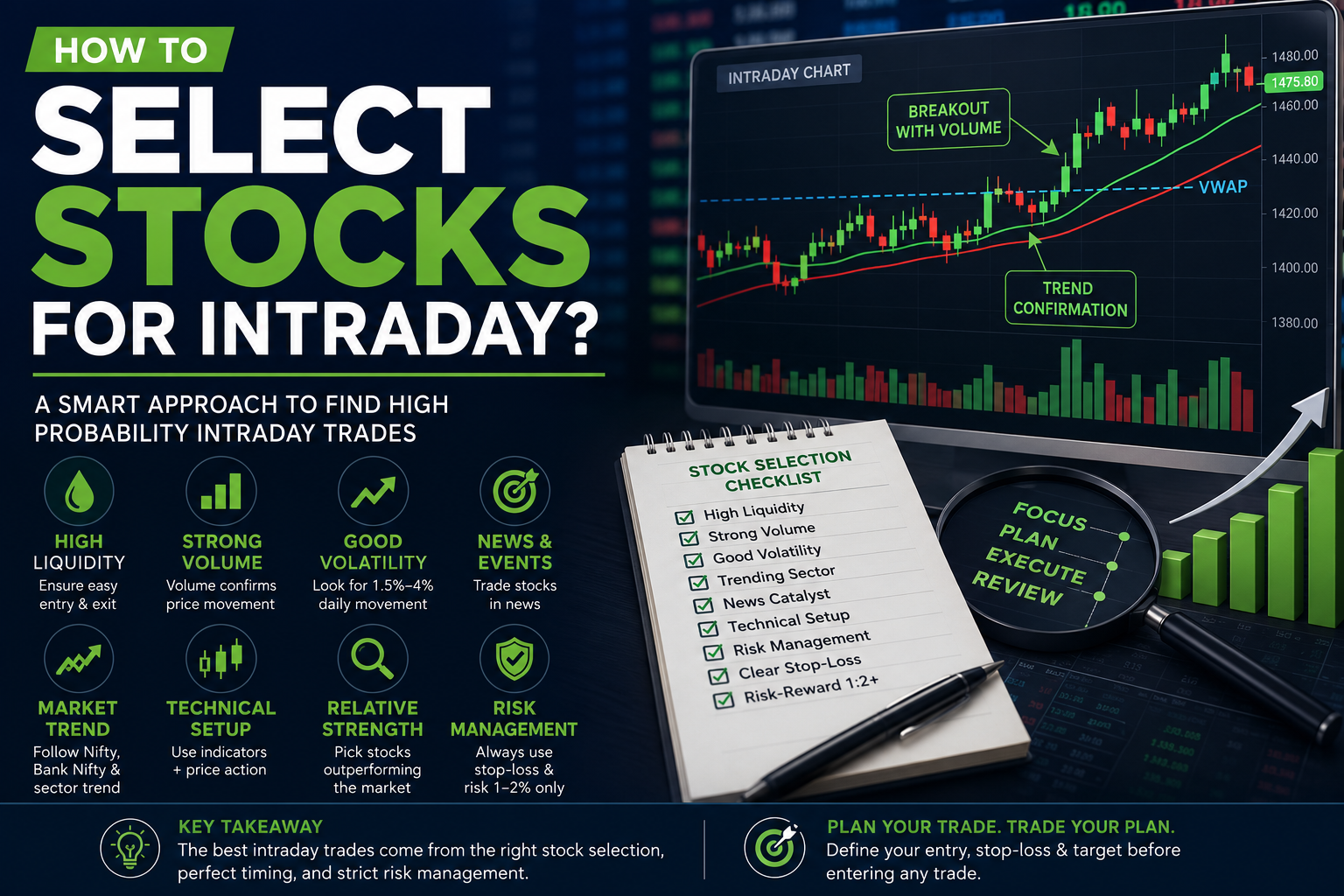
An ideal intraday stock is one that offers sufficient price movement and high trading activity during market hours.
Some of the key characteristics include:
These factors help traders enter and exit positions quickly without significant price differences.
Liquidity refers to how easily a stock can be bought or sold without affecting its price.
Highly liquid stocks usually have:
Most large-cap companies and actively traded stocks offer better liquidity than lesser-known companies.
For intraday traders, liquidity is often more important than the share price itself.
Volume indicates the number of shares traded during a particular period.
Stocks with consistently high trading volumes generally provide:
A sudden increase in trading volume may also indicate strong market interest following news or important events.
Price movement is essential for intraday trading.
If a stock barely moves throughout the day, there may not be enough opportunity to generate profits after accounting for brokerage charges and taxes.
However, excessive volatility can also increase risk.
Look for stocks that demonstrate healthy and consistent intraday price movements rather than unpredictable spikes.
Individual stocks often move in the same direction as the broader market.
Before selecting stocks, check the direction of major indices.
When the overall market is bullish, many quality stocks tend to move upward.
Similarly, during bearish market conditions, even fundamentally strong companies may witness selling pressure.
Trading in the direction of the broader market generally improves the probability of successful trades.
Stocks frequently react to important announcements such as:
Such events often increase trading volume and volatility, creating intraday opportunities.
However, traders should remain cautious because news-driven stocks can also experience sudden reversals.
Technical analysis plays an important role in identifying suitable intraday trading opportunities.
Some commonly used indicators include:
These tools help traders identify trends, momentum, and potential entry or exit points.
No indicator is perfect, so many experienced traders combine multiple indicators for confirmation.
Support and resistance levels help traders understand where buying or selling pressure may emerge.
Support is a price level where demand tends to increase.
Resistance is a price level where selling pressure often appears.
Stocks approaching these levels frequently provide potential trading opportunities.
Large-cap companies are generally more suitable for beginners because they offer:
Examples include companies from sectors such as banking, information technology, automobiles, and energy.
The difference between the buying price and selling price is called the bid-ask spread.
A wide spread increases trading costs and can reduce profitability, particularly for intraday traders who execute multiple trades.
Choosing stocks with narrow spreads allows for smoother execution.
Sometimes, an entire sector experiences strong momentum due to industry-specific developments.
For example:
Monitoring sector performance can help identify stocks with higher trading potential.
Many traders focus only on price movement without considering other important factors.
Some common mistakes include:
Low liquidity can make it difficult to enter or exit trades efficiently.
Trading against the broader market often increases risk.
Always rely on verified information rather than market speculation.
Monitoring too many stocks can reduce focus and lead to poor decision-making.
Many experienced traders concentrate on a small watchlist instead.
Selecting the right stock is only one part of successful intraday trading.
Proper risk management is equally important.
Some essential practices include:
Consistent discipline often contributes more to long-term success than finding the "perfect" stock.
Yes, beginners can participate in intraday trading, but they should start cautiously.
It is advisable to:
Building experience gradually is more effective than taking unnecessary risks.
Selecting the right stocks for intraday trading requires more than simply choosing the day's biggest gainers or most talked-about companies. Successful traders look for stocks with high liquidity, healthy trading volume, reasonable volatility, and clear price trends.
Combining market analysis with technical indicators and disciplined risk management can improve the quality of trading decisions. While no strategy guarantees profits, consistently following a structured approach can help traders navigate the fast-paced nature of intraday markets more effectively.
Stocks with high liquidity, strong trading volumes, moderate volatility, and active market participation are generally preferred for intraday trading.
Look for stocks with high trading volume, clear price trends, good liquidity, and significant movement during market hours.
Yes. High trading volume improves liquidity and makes it easier to enter and exit trades quickly.
Beginners are generally better off focusing on large-cap stocks because they tend to have better liquidity and lower price manipulation risks.
Banking, information technology, automobiles, pharmaceuticals, energy, and financial services often provide active intraday trading opportunities.
Technical indicators are useful tools, but they should be combined with price action, market trends, volume analysis, and proper risk management.
Most traders monitor a limited watchlist of 5 to 10 stocks to maintain focus and react quickly to market movements.
Liquidity is one of the most important factors because it allows traders to execute orders efficiently without significant price differences.