
 Aug-24-2026
What Are Currency Futures? Meaning, Trading, Benefits & Examples
Learn what currency futures are, how currency futures trading works in India, their benefits, risks, margin requirements, settlement and examples of forex futures.
currency-futures-meaning-trading
Currency futures
What are currency futures
Currency futures trading
Forex futures
Currency derivatives
USD INR futures
Currency trading in India
Currency futures example
Currency futures hedging
Currency futures vs forex
Currency futures contract
Exchange rates keep changing. The Indian rupee may strengthen against the US dollar one day and weaken the next. For businesses dealing internationally, these movements can directly affect revenue, costs and profitability.
Currency futures provide a way to manage this uncertainty.
A currency futures contract is a standardised exchange-traded derivative that allows participants to take a position on the future exchange rate of one currency against another.
For example, USD/INR futures are based on the exchange rate between the US dollar and Indian rupee.
Businesses may use currency futures to protect themselves against unfavourable exchange-rate movements, while traders may use them to take a view on whether a currency will strengthen or weaken.
Currency futures are traded in pairs.
Consider USD/INR.
If USD/INR is trading at 87.00, it broadly means one US dollar is valued at ₹87.
A trader expecting the dollar to strengthen against the rupee may buy USD/INR futures.
If the futures price later rises to 87.50, the trader may make a profit by closing the position at the higher price.
On the other hand, a trader expecting the dollar to weaken may sell USD/INR futures.
The actual profit or loss depends on:
Entry price
Exit price
Contract size
Number of contracts
Transaction costs
Suppose a trader buys one USD/INR futures contract at ₹87.00.
Assume the contract represents USD 1,000.
Later, the futures price rises to ₹87.40.
Difference:
₹87.40 − ₹87.00 = ₹0.40
Approximate gross profit:
₹0.40 × 1,000 = ₹400
If the price had fallen from ₹87.00 to ₹86.60 instead, the approximate gross loss would be ₹400.
This example excludes brokerage, statutory charges, taxes and possible execution differences.
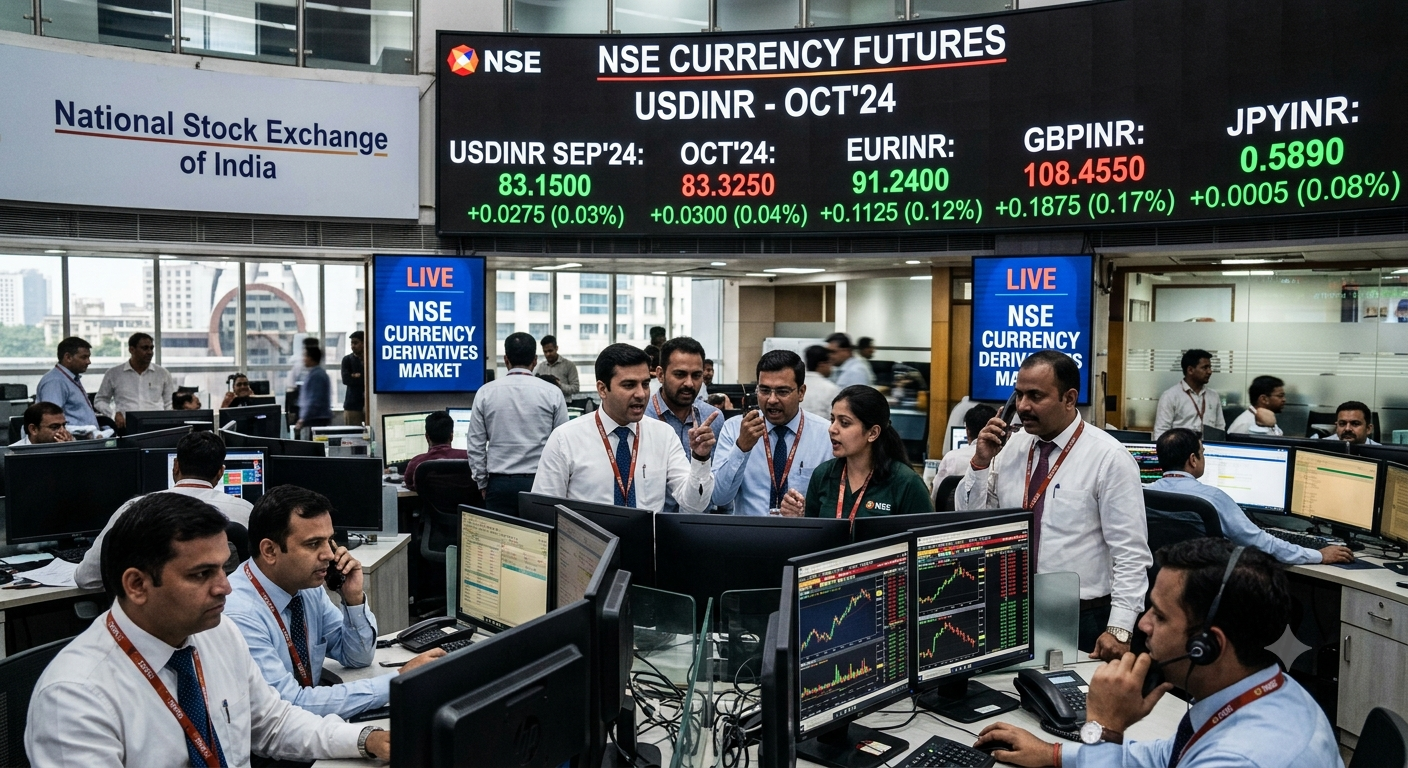
Currency derivatives in India may include INR-based currency pairs such as:
USD/INR – US Dollar and Indian Rupee
EUR/INR – Euro and Indian Rupee
GBP/INR – British Pound and Indian Rupee
JPY/INR – Japanese Yen and Indian Rupee
Exchange availability and contract specifications can change, so traders should check the latest exchange circulars before trading.
USD/INR is one of the most closely watched currency pairs in India.
Suppose:
USD/INR = 87.00
This means approximately ₹87 are required for one US dollar.
If USD/INR moves from 87 to 88:
US dollar has strengthened relative to the rupee.
Indian rupee has weakened relative to the dollar.
If USD/INR falls from 87 to 86:
US dollar has weakened relative to the rupee.
Indian rupee has strengthened relative to the dollar.
Understanding this relationship is fundamental to currency trading.
Currency prices are affected by several domestic and international factors.
Central bank interest-rate decisions can influence demand for a currency.
Changes in monetary policy by the Reserve Bank of India, US Federal Reserve and other major central banks can therefore affect exchange rates.
Persistently high inflation can reduce the purchasing power of a currency and influence its long-term value.
Strong economic growth can improve investor confidence and attract foreign capital.
Foreign institutional investment into or out of Indian financial markets can affect demand for the rupee.
India imports a significant amount of crude oil. A sharp increase in global crude prices can increase demand for foreign currency and influence the rupee.
The difference between a country's exports and imports can affect currency demand and supply.
Wars, trade disputes, sanctions and political uncertainty can cause rapid movements in global currencies.
Central banks may participate in foreign exchange markets as part of their broader currency and liquidity management policies.
One of the most important uses of currency futures is hedging.
Hedging means taking a position designed to reduce the financial impact of an unfavourable exchange-rate movement.
Consider an Indian importer that must pay USD 1,00,000 to an overseas supplier after three months.
Suppose the current exchange rate is ₹87 per dollar.
Current rupee equivalent:
₹87 × 1,00,000 = ₹87 lakh
The importer is concerned that USD/INR may rise to ₹90 before payment is due.
At ₹90, the same payment would cost:
₹90 × 1,00,000 = ₹90 lakh
That is an additional ₹3 lakh.
The importer may use USD/INR futures to hedge part or all of this currency exposure.
If the dollar strengthens, gains on the futures position may help offset the higher cost of buying dollars.
The hedge may not be exact because of contract specifications, timing, basis movements and transaction costs.
Exporters face the opposite risk.
Suppose an Indian exporter expects to receive USD 1,00,000 after three months.
If USD/INR is currently ₹87, the expected rupee value is ₹87 lakh.
The exporter may be concerned that the rupee will strengthen and USD/INR will fall to ₹84.
At ₹84, the exporter would receive only ₹84 lakh after conversion.
The exporter may therefore consider selling USD/INR futures to hedge against a decline in the dollar's value relative to the rupee.
Currency futures are used by different types of market participants.
Importers may hedge against a rise in the cost of foreign currencies.
Exporters may hedge against a decline in the value of foreign-currency receivables.
Investors with international exposure may use currency derivatives as part of their risk-management strategy.
Currency traders may take positions based on expected movements in exchange rates.
Banks and other financial institutions may use currency derivatives for risk management and other permitted market activities.
Currency futures are margin-based products.
A trader generally does not need to deposit the full notional value of the contract. Instead, the required margin must be maintained.
Suppose a futures position has a notional value of ₹8,70,000 and the applicable margin requirement is ₹30,000.
The trader controls the larger position by depositing the required margin.
This creates leverage.
Leverage can improve capital efficiency, but it also increases risk because profit and loss are calculated on the contract exposure rather than simply on the margin deposited.
Consider two traders.
Trader A invests ₹1 lakh in an unleveraged investment.
Trader B deposits ₹1 lakh as margin to control a substantially larger futures exposure.
A relatively small percentage movement in the underlying currency can therefore have a much larger percentage impact on Trader B's deposited capital.
This works both ways.
Leverage can magnify profits, but it can magnify losses just as quickly.
Currency futures positions are subject to daily settlement.
The profit or loss on an open position is calculated according to changes in the futures settlement price.
This process is commonly known as mark-to-market (MTM).
Suppose a trader buys USD/INR futures at 87.00 and the relevant settlement price rises to 87.20.
The trader has an MTM gain.
If the settlement price falls to 86.80, the trader has an MTM loss.
Adequate funds must be maintained to meet applicable margin requirements.
Currency futures have predetermined expiry dates.
A trader generally has three choices:
Close the position before expiry.
Roll the position into another contract.
Allow the position to reach final settlement.
INR currency futures traded on Indian exchanges are generally settled in cash in Indian rupees according to the applicable exchange settlement mechanism.
This means traders do not normally receive physical US dollars, euros or pounds simply because an exchange-traded INR currency futures contract expires.
Currency derivatives have their own trading schedule, which may differ from the regular equity cash market.
For major INR currency futures contracts, trading generally takes place on exchange business days during the prescribed currency derivatives session.
Traders should always check current exchange timings because trading hours and expiry procedures can be revised through exchange circulars.
Currency futures and currency options are both derivatives, but their payoff structures differ.
| Currency Futures | Currency Options |
|---|---|
| Creates an obligation under the futures contract | Buyer receives a right, not an obligation |
| Margin is required | Option buyer pays premium |
| Profit and loss move relatively directly with futures price | Payoff depends on strike price, premium and market price |
| Potential loss can be substantial | Buyer's loss is generally limited to premium paid |
| Commonly used for hedging and directional trading | Can be used for hedging and structured strategies |
Neither product is automatically better. The appropriate instrument depends on the objective and risk profile.
| Currency Futures | Spot Currency Market |
|---|---|
| Standardised exchange-traded contracts | Transaction in the underlying currency market |
| Fixed contract specifications | Transaction size may depend on market arrangement |
| Predetermined expiry | Spot transactions follow applicable settlement conventions |
| Exchange-based price discovery | Prices arise in the foreign exchange market |
| Margin-based trading | Depends on transaction structure |
| Regulated exchange mechanism | Structure varies by participant and market |
Businesses can use futures to reduce uncertainty surrounding future foreign-currency payments or receipts.
Exchange-traded contracts provide visible market prices and standardised specifications.
Currency futures are traded through recognised exchanges and clearing mechanisms.
Participants can take positions based on expectations of currency appreciation or depreciation.
Margin-based trading means the full contract value does not need to be deposited upfront.
Currency exposure may behave differently from equities and other asset classes, although diversification does not guarantee protection from losses.
Because futures use margin, relatively small exchange-rate movements can generate substantial gains or losses.
Currency prices can move quickly following economic or geopolitical developments.
Adverse price movements can increase margin requirements or create additional funding obligations.
Central-bank decisions, inflation data, employment reports and political events can cause sudden volatility.
Prices can move sharply between trading sessions or immediately after important announcements.
A hedge may not perfectly offset the underlying currency exposure.
Liquidity can vary across currency pairs and expiry contracts.
Not every participant uses futures for hedging.
A trader who expects the dollar to strengthen against the rupee may consider buying USD/INR futures.
A trader expecting the dollar to weaken may consider selling USD/INR futures.
However, predicting short-term currency movements is difficult.
Exchange rates respond to numerous variables simultaneously, including:
Interest-rate expectations
Inflation
Global bond yields
Economic data
Foreign investment flows
Crude oil prices
Political developments
Central-bank communication
Directional currency trading therefore requires disciplined risk management.
Professional traders may also monitor differences between:
Spot exchange rates
Futures prices
Different futures expiries
When temporary pricing differences arise, arbitrage strategies may attempt to capture the discrepancy.
However, arbitrage requires careful consideration of funding costs, transaction costs, execution speed, margins and applicable market regulations.
Before taking a currency futures position, traders should understand:
Contract size
Expiry date
Tick size
Margin requirement
Daily settlement mechanism
Currency pair
Trading hours
Current volatility
Upcoming economic events
Maximum acceptable loss
A currency trade should not be entered simply because the exchange rate appears high or low.
Know how much capital you are prepared to lose before placing the trade.
Do not evaluate risk based only on margin.
Calculate the full notional value of the futures position.
Larger positions magnify both gains and losses.
Keeping only the minimum required margin can create problems during volatile sessions.
Important events include:
RBI monetary policy decisions
US Federal Reserve meetings
Inflation data
Employment reports
GDP releases
Major geopolitical developments
Just because a broker permits a position does not mean the position is suitable for your capital or risk tolerance.
Currency futures may look straightforward because the underlying concept is simply one currency moving against another.
In practice, currency markets are influenced by complex global factors.
A beginner should understand:
How currency pairs are quoted
Futures contract specifications
Margin and leverage
MTM settlement
Expiry
Economic indicators
Interest-rate relationships
Risk management
Understanding these concepts before committing capital can reduce avoidable mistakes.
Currency futures provide an exchange-traded way to manage or take exposure to movements in foreign exchange rates.
For importers and exporters, they can be valuable hedging instruments. For traders, they provide an opportunity to take a view on the direction of currencies such as the US dollar, euro, pound and Japanese yen against the Indian rupee.
However, currency futures are leveraged products. A small exchange-rate movement can create a meaningful gain or loss relative to the margin deposited.
Anyone using currency futures should therefore understand the contract specifications, total exposure, margin requirements and potential downside before entering a position.
Used with proper planning, currency futures can be an effective risk-management instrument. Used without adequate understanding of leverage, they can create losses much larger than expected.
Currency futures are standardised exchange-traded derivative contracts whose value is linked to the exchange rate between two currencies.
USD/INR futures are an example. Their value is linked to the exchange rate between the US dollar and Indian rupee.
Major INR currency pairs include USD/INR, EUR/INR, GBP/INR and JPY/INR, subject to current exchange availability.
Importers and exporters may use currency futures to reduce the financial impact of adverse exchange-rate movements.
Eligible traders can access exchange-traded currency derivatives through brokers offering the currency derivatives segment, subject to applicable regulations and account requirements.
Yes. Currency futures involve leverage, exchange-rate risk, margin risk and the possibility of substantial losses.
INR currency futures traded on Indian exchanges are generally cash-settled in Indian rupees according to applicable exchange rules.
Margin is the amount that must be maintained to initiate and hold a futures position. It represents only a portion of the contract's total exposure.
Futures create contractual obligations for both sides, while an option buyer receives a right without an obligation to exercise the option. The payoff and risk structures are therefore different.
Yes. Hedging foreign-currency receivables and payments is one of the primary uses of currency futures.
A rise in USD/INR generally means the US dollar has strengthened relative to the Indian rupee, or equivalently that the rupee has weakened relative to the dollar.
Factors include interest rates, inflation, crude oil prices, foreign investment flows, trade balances, economic growth, central-bank policies and geopolitical developments.
What are currency futures?
How do currency futures work in India?
What is an example of currency futures?
Which currency futures are traded in India?
How are currency futures used for hedging?
What is margin in currency futures?
Are currency futures cash-settled?
What are the risks of currency futures trading?
What is the difference between currency futures and currency options?
How does USD/INR futures trading work?
Can individuals trade currency futures in India?
What factors affect currency futures prices?