
 Aug-31-2026
When evaluating a stock, looking at its market price alone does not tell you whether the company is expensive or reasonably valued. Investors often compare the share price with different financial measures to get a clearer picture of valuation.
One such measure is the Price-to-Book Ratio, commonly known as the P/B Ratio.
The P/B ratio compares a company's current market price per share with its book value per share. In simple terms, it tells investors how much the market is willing to pay for every rupee of the company's net assets.
For example, a P/B ratio of 2 means investors are paying ₹2 in the market for every ₹1 of book value represented by the share.
The ratio is particularly useful when analysing banks, financial institutions and asset-heavy businesses where balance-sheet assets play an important role in determining value.
The Price-to-Book ratio compares two values:
Market Price per Share – the price at which the company's shares are currently trading.
Book Value per Share – the accounting value attributable to each equity share after deducting liabilities from assets.
If a company has a P/B ratio of 3, it means its shares are trading at three times their book value.
A higher ratio may indicate that investors expect strong profitability or future growth. A lower ratio may indicate that the stock is inexpensive relative to its book value, but it can also signal concerns about the company's financial performance.
Therefore, the P/B ratio should not be interpreted in isolation.
The basic formula is:
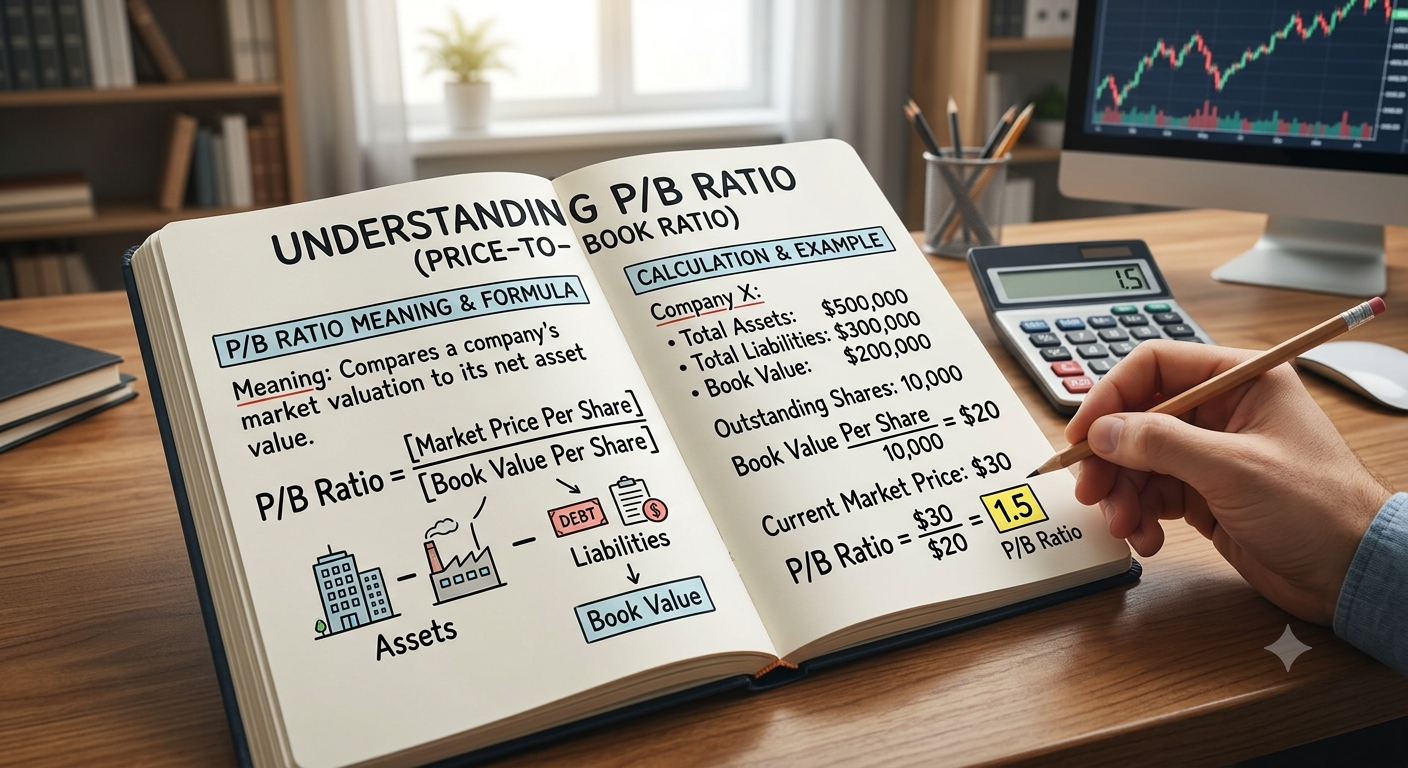
P/B Ratio = Market Price per Share ÷ Book Value per Share
For example:
P/B Ratio:
₹600 ÷ ₹200 = 3
The company is therefore trading at 3 times its book value.
Book value represents the net accounting value of a company.
A simplified formula is:
Book Value = Total Assets − Total Liabilities
Suppose a company has:
Its book value would be:
₹1,000 crore − ₹600 crore = ₹400 crore
This represents the accounting value attributable to shareholders, subject to the exact balance-sheet classification used.
Book Value Per Share, or BVPS, indicates the book value attributable to each outstanding equity share.
A commonly used formula is:
Book Value Per Share = Equity Available to Common Shareholders ÷ Number of Outstanding Equity Shares
Suppose:
Book value per share:
₹400 crore ÷ 2 crore = ₹200
If the market price is ₹500:
P/B Ratio:
₹500 ÷ ₹200 = 2.5
The stock is trading at 2.5 times its book value.
Consider Company ABC.
Suppose its financial information is:
First, calculate book value:
₹5,000 crore − ₹3,000 crore = ₹2,000 crore
Next, calculate book value per share:
₹2,000 crore ÷ 5 crore = ₹400
Now calculate P/B:
₹750 ÷ ₹400 = 1.875
The company's P/B ratio is approximately 1.88.
This means investors are paying around ₹1.88 for every ₹1 of the company's book value.
Understanding the number is more important than simply calculating it.
A P/B ratio above 1 means the company's market value is higher than its book value.
This may happen because investors expect:
A high P/B ratio does not automatically mean the stock is overvalued.
A P/B ratio below 1 means the company's market value is lower than its reported book value.
For example:
P/B Ratio:
₹150 ÷ ₹200 = 0.75
At first glance, this may appear inexpensive.
However, investors should investigate why the market is assigning a lower valuation.
Possible reasons include:
A P/B below 1 is therefore not automatically a buying opportunity.
There is no single P/B ratio that can be considered good for every company.
A reasonable P/B ratio depends on:
A P/B ratio of 3 may appear expensive for one company but reasonable for another company generating consistently high returns on equity.
The best comparison is usually between companies operating in the same industry.
The P/B ratio is frequently used while analysing banks and financial institutions.
Banks operate largely through financial assets and liabilities. Their balance sheets therefore provide important information about their underlying business value.
When evaluating a bank using P/B, investors commonly consider factors such as:
A bank with consistently high profitability and strong asset quality may trade at a higher P/B multiple than a weaker competitor.
P/B is not equally useful for every business.
Consider a technology or software company.
Its most valuable assets may include:
Many of these assets may not be fully represented in accounting book value.
As a result, such companies can trade at very high P/B multiples without necessarily being overvalued.
P/B analysis is generally more intuitive for asset-heavy businesses than for companies whose value depends heavily on intangible assets.
P/B ratio should often be considered alongside Return on Equity (ROE).
ROE measures how effectively a company generates profits from shareholders' equity.
Consider two companies:
| Particulars | Company A | Company B |
|---|---|---|
| P/B Ratio | 4 | 1.5 |
| ROE | 25% | 7% |
Company A appears more expensive based only on P/B.
However, it is also generating significantly higher returns on shareholders' capital.
The higher valuation may therefore be partly justified by superior profitability.
This is why investors should not simply select the company with the lowest P/B ratio.
P/B and P/E are both valuation ratios, but they measure different things.
| Basis | P/B Ratio | P/E Ratio |
| Full Name | Price-to-Book Ratio | Price-to-Earnings Ratio |
| Compares Price With | Book value | Earnings |
| Focus | Balance sheet | Profitability |
| Useful For | Banks and asset-heavy businesses | Profitable companies across many sectors |
| Formula | Price ÷ Book Value Per Share | Price ÷ Earnings Per Share |
| Main Question | How much am I paying for net assets? | How much am I paying for earnings? |
Using both ratios together can provide a broader valuation perspective.
Book value and P/B ratio are related but are not the same.
Book value represents the company's accounting net worth.
P/B ratio compares the market valuation with that accounting value.
For example:
Book value tells you the accounting value per share, while P/B tells you how the market is valuing that book value.
The ratio requires only the share price and book value per share.
P/B can help compare banks or businesses within the same industry.
A company may temporarily report very low or negative earnings, making the P/E ratio difficult to interpret. Book value may sometimes provide an alternative reference point.
P/B gives investors a valuation perspective based on net assets rather than only current earnings.
Value investors sometimes use P/B to identify companies trading close to or below their book value before conducting deeper research.
The reported value of assets may differ significantly from their current economic or market value.
Brands, intellectual property and human capital may not be fully captured in traditional book value.
Comparing the P/B ratio of a bank with a software company provides little meaningful information.
A stock may look inexpensive because the underlying business is deteriorating.
A company can have substantial book value but generate poor returns from those assets.
A value trap is a stock that appears cheap based on valuation ratios but remains inexpensive because the business has fundamental problems.
For example, a company may trade at a P/B of 0.6 because of:
Buying merely because the P/B ratio is below 1 can therefore expose investors to significant risk.
Before investing based on P/B, investors should also examine:
For banks, investors may additionally analyse NPA ratios, capital adequacy, margins and provisioning.
Suppose three banks have the following valuations:
| Bank | P/B Ratio | ROE |
| Bank A | 1.2 | 8% |
| Bank B | 2.0 | 15% |
| Bank C | 3.0 | 21% |
Looking only at P/B would make Bank A appear cheapest.
However, Bank C is generating a much higher return on equity.
The investor must determine whether Bank C's higher profitability, growth prospects and asset quality justify paying the higher multiple.
Valuation is therefore about the relationship between price and business quality, not simply finding the lowest ratio.
A meaningful conventional P/B comparison becomes difficult when a company has negative shareholders' equity.
If liabilities exceed the relevant accounting assets and book value becomes negative, the resulting P/B number generally provides little useful valuation insight.
In such situations, investors should focus on the reason for negative net worth and evaluate the company's financial position carefully.
Not necessarily.
A high P/B ratio may indicate that investors expect the company to:
However, paying a very high valuation increases expectations. If future performance disappoints, the stock may experience valuation compression.
Not automatically.
A low P/B ratio may indicate undervaluation, but it can also signal:
Investors should identify the reason behind the low valuation before making a decision.
Before considering a stock based on P/B, ask:
This approach provides far more information than using a single valuation number.
The Price-to-Book ratio is a useful valuation tool that compares a company's market price with its accounting book value.
A low P/B ratio may highlight a potentially inexpensive stock, while a higher P/B may indicate that investors are willing to pay a premium for better profitability, growth or business quality.
However, neither a high nor low P/B ratio should be treated as an automatic buy or sell signal.
The ratio becomes far more useful when compared with industry peers, historical valuations, return on equity, asset quality and the company's future growth prospects.
For sectors such as banking and financial services, P/B can be particularly valuable. For businesses driven heavily by intangible assets, other valuation measures may provide additional insight.
Ultimately, P/B is best used as one part of a broader fundamental analysis rather than as a standalone investment decision.
P/B ratio, or Price-to-Book ratio, compares a company's market price per share with its book value per share.
The formula is:
P/B Ratio = Market Price Per Share ÷ Book Value Per Share
It means investors are paying ₹2 in market value for every ₹1 of the company's book value per share.
There is no universally good P/B ratio. It should be compared with companies in the same industry, the company's historical valuation and its profitability.
It may indicate that the stock is trading below book value, but it can also signal weak profitability, poor asset quality or other business problems.
Not necessarily. Companies with high profitability, strong growth and superior return on equity may justify higher P/B multiples.
P/B is frequently used for banks, financial institutions and other businesses where balance-sheet assets are an important part of valuation.
Book value per share represents the accounting equity attributable to each outstanding common share.
P/B compares market price with book value, while P/E compares market price with earnings per share.
It is better to combine P/B with profitability, ROE, debt, asset quality, growth prospects and other valuation measures.
The market may assign higher valuations to businesses with superior profitability, high ROE, strong growth prospects or valuable intangible assets.
Yes. P/B is commonly used in bank valuation because shareholders' equity and balance-sheet quality are important indicators of a bank's financial position.