
 Jul-27-2026
What Are Upper and Lower Circuits in the Stock Market? Stock prices can sometimes rise or fall sharply within a few minutes. Such movements may be triggered by company announcements, market rumours, economic developments or sudden changes in investor sentiment.
To control extreme price movements, stock exchanges apply upper and lower circuit limits. These limits define how much the price of a stock can rise or fall during a trading session.
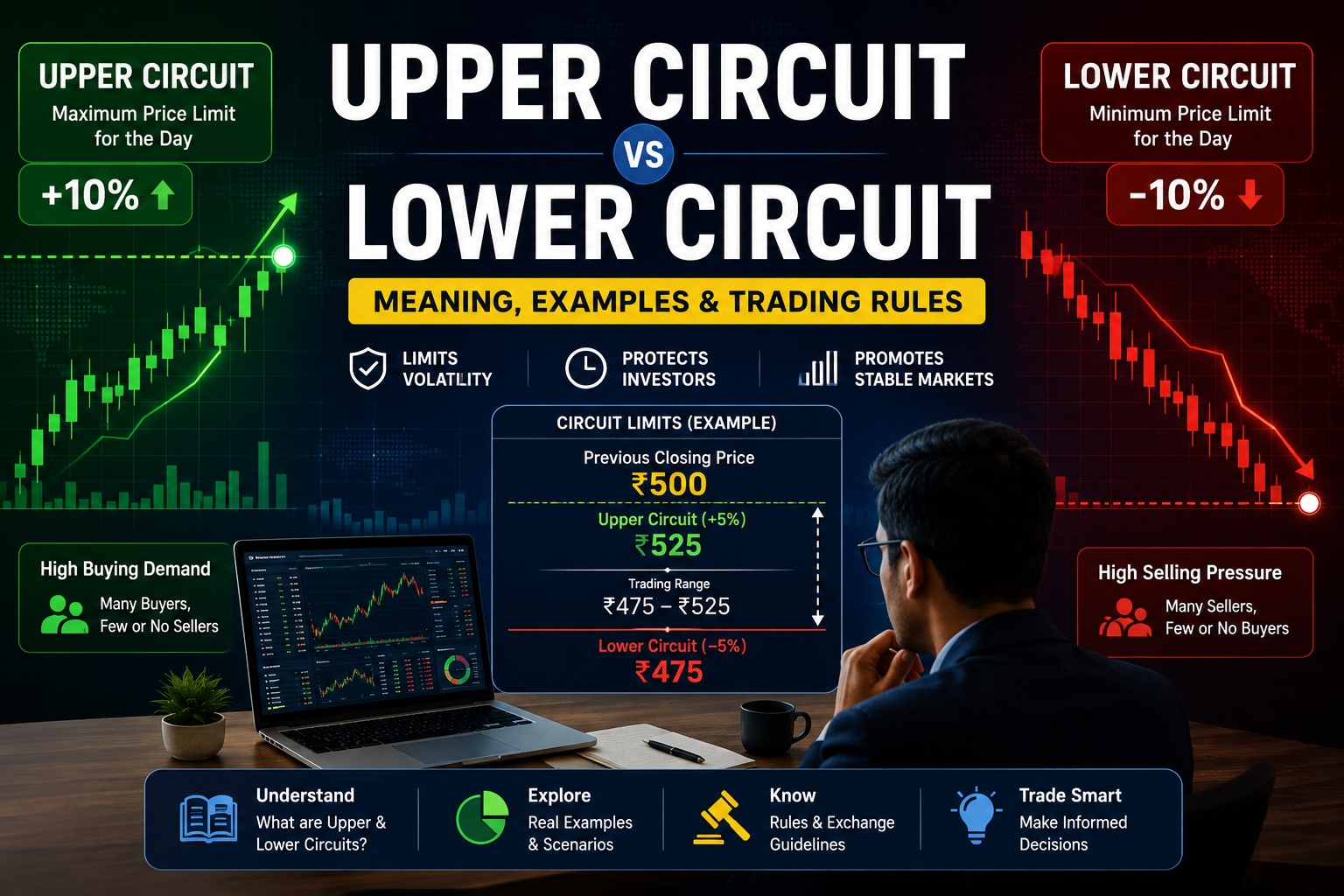
An upper circuit sets the maximum price at which a stock can trade for the day. A lower circuit sets the minimum price.
Circuit limits are designed to reduce excessive volatility and give investors time to assess the situation instead of reacting in panic.
What Is an Upper Circuit? An upper circuit is the highest price that a stock is permitted to reach during a trading session.
Once the stock reaches this level, no trades can take place above the prescribed price. In many cases, there may be several buyers but very few or no sellers.
This situation is commonly described as a stock being locked in the upper circuit.
Example of an Upper Circuit Suppose a stock closed at ₹200 on the previous trading day and has a 10% price band.
Its upper circuit for the next session would be:
₹200 + 10% = ₹220
The stock cannot trade above ₹220 during that session unless the exchange revises the applicable price band.
What Is a Lower Circuit? A lower circuit is the lowest price at which a stock can trade during a particular session.
When the stock reaches this limit, no trades can take place below the prescribed price. There may be many sellers but very few or no buyers.
This can make it difficult for existing shareholders to exit their positions.
Example of a Lower Circuit Suppose a stock closed at ₹200 and has a 10% price band.
Its lower circuit would be:
₹200 − 10% = ₹180
The stock cannot trade below ₹180 during that trading session.
How Are Circuit Limits Calculated? Circuit limits are generally calculated using the stock’s previous closing price.
Common price bands may include:
2%
5%
10%
20%
The applicable limit depends on the stock’s trading category, liquidity, volatility and exchange rules.
For example, if a stock closes at ₹500 and has a 5% circuit limit:
Upper circuit: ₹525
Lower circuit: ₹475
The stock can trade only within this range during the session.
Why Do Stocks Hit the Upper Circuit? A stock usually hits the upper circuit when buying demand is much higher than the available supply.
Possible reasons include:
Strong Financial Results Better-than-expected revenue or profit can attract significant buying interest.
Large Business Orders A major contract or project win may improve expectations about future earnings.
Merger or Acquisition News Investors may expect higher business value following a merger, acquisition or strategic partnership.
Positive Regulatory Development Government approvals, policy changes or favourable court decisions may improve market sentiment.
Short Covering Traders holding short positions may rush to buy the stock when its price starts rising. This additional demand can push the stock towards its upper circuit.
Market Speculation In some cases, a stock may hit the upper circuit because of rumours or speculative activity rather than any genuine improvement in the business.
Why Do Stocks Hit the Lower Circuit? A lower circuit usually occurs when selling pressure is extremely high and there are not enough buyers.
Common triggers include:
Weak Financial Results A sharp decline in revenue, profit or margins can lead to heavy selling.
Corporate Governance Concerns Accounting irregularities, regulatory investigations or management disputes may damage investor confidence.
Debt or Default Risk Concerns about the company’s ability to repay its liabilities can trigger panic selling.
Negative News The loss of a major customer, cancellation of a contract or an unfavourable policy decision may affect the stock price.
Broader Market Panic During a major market decline, highly volatile or less liquid stocks may quickly reach their lower circuits.
Upper Circuit vs Lower Circuit Basis Upper Circuit Lower Circuit Meaning Maximum permitted price for the day Minimum permitted price for the day Market situation Strong buying pressure Strong selling pressure Order book Mostly buyers Mostly sellers Execution risk Buyers may not get shares Sellers may not find buyers General sentiment Bullish or speculative Bearish or panic-driven What Happens When a Stock Hits the Upper Circuit? When a stock reaches its upper circuit, investors may continue placing buy and sell orders at the circuit price.
However, order execution depends on whether a matching seller is available.
A stock hitting the upper circuit does not always mean that trading in the stock is completely suspended. Trading may continue at the permitted price if matching orders are available.
In a one-sided market, buyers may remain queued because no shareholder is willing to sell.
When a stock reaches its lower circuit, sell orders may remain pending if there are no buyers.
This is one of the biggest risks of trading in illiquid or highly speculative stocks. Even when an investor wants to exit, the order may not be executed.
The position may remain open until sufficient buying interest appears or the price band changes in a later session.
You can place a buy order at the upper circuit price, but execution is not guaranteed.
When a stock is locked in the upper circuit, demand is usually high and supply is limited. Your order may remain pending in the exchange order book.
Buying purely because a stock has reached its upper circuit can be risky. The rise may be driven by speculation rather than business fundamentals.
You can place a sell order at the lower circuit price, but it will be executed only when a buyer is available.
In a stock with continuous lower circuits, sellers may remain trapped for several sessions.
This is why liquidity should be evaluated before entering small-cap, micro-cap or low-volume stocks.
A sell order placed at the upper circuit may have a better chance of execution because there are usually several buyers waiting at that price.
However, execution still depends on order priority, quantity and the availability of matching buy orders.
A buy order may be placed at the lower circuit because there are often several sellers.
However, a stock trading at the lower circuit should not automatically be treated as a bargain.
The price may continue falling in subsequent sessions if the underlying problem remains unresolved.
Circuit breakers are also applied at the broader market level.
Unlike stock-specific price bands, index circuit breakers are triggered by sharp movements in major benchmark indices.
Market-wide circuit levels are generally linked to movements of:
When these levels are triggered, trading may be paused across the equity and equity-derivatives markets.
The duration of the halt depends on the size of the movement and the time at which it occurs.
| Stock Circuit | Market-Wide Circuit Breaker |
| Applies to an individual security | Applies across the market |
| Restricts the stock’s trading range | Temporarily pauses market trading |
| Usually based on the previous closing price | Triggered by movements in benchmark indices |
| May be set at different percentages | Common trigger levels are 10%, 15% and 20% |
Stocks available in the derivatives segment generally operate differently from securities with fixed daily circuit filters because derivatives allow price discovery through futures and options.
However, exchanges may apply operating ranges, dynamic price bands or other surveillance measures to control abnormal orders and excessive volatility.
The exact treatment may vary depending on the security and prevailing exchange rules.
Circuit stocks can appear attractive because of their sharp price movements. However, they carry substantial execution and liquidity risks.
A shareholder may be unable to sell a stock locked in the lower circuit.
A buy order in an upper-circuit stock may remain pending because no seller is available.
Low-volume stocks can be influenced by concentrated buying or selling activity.
The stock may open directly at another circuit level in the next session.
Repeated upper circuits may create the impression of strong performance even when the company’s fundamentals remain weak.
Before placing an order, review:
A price movement should be supported by credible information. Market rumours and social-media messages should not be treated as investment research.
A stock reaching its upper circuit may appear to be performing well, but the movement could be driven by limited supply, speculation or operator activity.
A good investment decision should be based on business performance, management quality, earnings visibility, balance-sheet strength and valuation.
The circuit level only describes the permitted trading range. It does not establish whether the stock is fairly valued.
A sharp price decline may make a stock look cheap, but a lower price does not automatically mean a lower valuation risk.
The company may be facing serious financial, regulatory or governance issues.
Investors should understand why the stock is falling before considering a purchase.
Circuit limits slow down extreme price movements, but they do not eliminate investment risk.
In some situations, they may delay price discovery across multiple sessions. A stock can hit the lower circuit repeatedly until buyers return.
Investors should therefore use circuit information along with:
Depending only on a stop-loss may not be sufficient because a stop-loss order cannot execute when there is no matching buyer.
Upper and lower circuits are safeguards that restrict extreme daily price movements in individual stocks. The upper circuit sets the highest permitted price, while the lower circuit sets the lowest.
These limits can reduce disorderly trading, but they do not guarantee liquidity or protect investors from losses. A stock may remain locked at a circuit level for several sessions, making it difficult to enter or exit.
Investors should avoid treating circuit movements as automatic buy or sell signals. The reason behind the movement, company fundamentals, trading volume and order-book liquidity should always be examined before making a decision.
An upper circuit is the maximum price at which a stock is allowed to trade during a particular session.
A lower circuit is the minimum price at which a stock can trade during a particular session.
It is usually calculated as a fixed percentage above and below the previous trading session’s closing price.
You can place a buy order, but it may not be executed if there are no sellers.
You can place a sell order, but execution is not guaranteed if there are no buyers.
Not necessarily. The movement may be based on genuine developments, speculation or low liquidity. The company’s fundamentals should be checked before investing.
Buying at the lower circuit can be risky because the stock may continue falling in later sessions.
It is a mechanism that temporarily pauses trading across the market when a benchmark index rises or falls by a specified percentage.
A stop-loss order requires a matching buyer. It may remain unexecuted when a stock is locked in the lower circuit with only sellers.
Yes. A stock can hit its upper or lower circuit for several consecutive sessions depending on demand, supply and market developments.