
 Jul-06-2026
Short covering is a market situation where traders who have previously sold a stock short buy it back to close their positions. This buying activity often pushes the stock price higher, especially if many traders attempt to exit their short positions at the same time.
Short covering is common in both the cash and derivatives markets and usually occurs when traders believe the stock may continue to rise, making it risky to maintain their short positions.
Understanding short covering can help traders identify sudden price movements and distinguish them from genuine buying interest.
Before understanding short covering, it's important to know how short selling works.
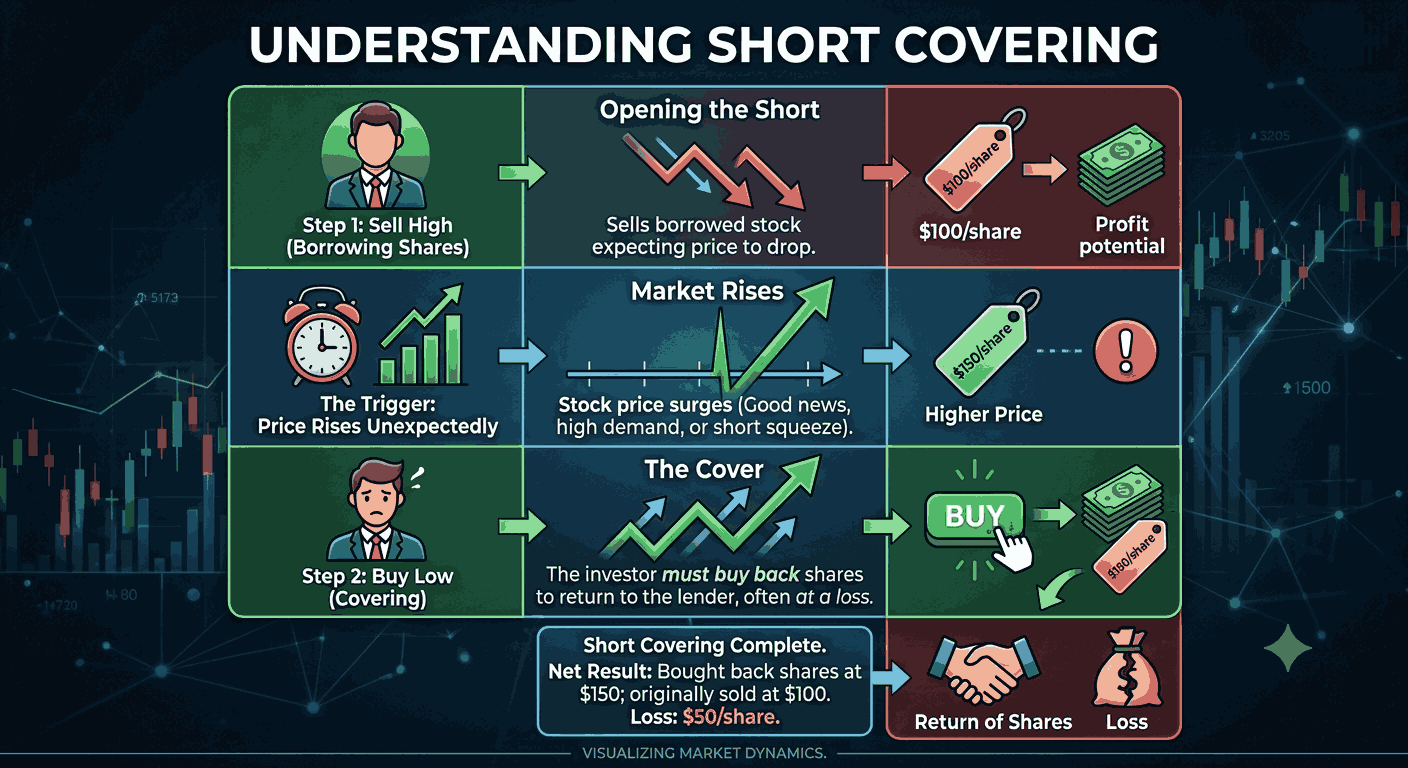
In short selling, a trader expects the price of a stock to decline. Instead of buying first, the trader sells borrowed shares and plans to buy them back later at a lower price.
For example:
The profit is:
₹500 − ₹450 = ₹50 per share
However, if the stock rises instead of falling, the trader faces a loss.
This is where short covering comes into play.
Short covering occurs when traders buy back shares that they had previously sold short.
This buying is done to:
Since buying demand increases during short covering, stock prices often move higher in a short period.
Suppose a trader believes that the shares of Company XYZ will decline.
The trader:
Instead, the company announces better-than-expected quarterly results, and the stock jumps to ₹860.
To avoid larger losses, the trader buys back the 500 shares at ₹860 and closes the short position.
This buying activity is known as short covering.
If many traders do the same simultaneously, the stock can witness a sharp rise in price.
Several factors can trigger short covering.
Strong quarterly earnings, new business announcements, or major contracts can force short sellers to exit their positions.
When a company's financial performance exceeds market expectations, traders betting against the stock may quickly buy back shares.
A stock breaking above an important resistance level can trigger automated buying by short sellers.
When the overall market turns bullish, traders often reduce bearish positions, leading to short covering.
If losses increase significantly, brokers may require traders to close their short positions, resulting in additional buying pressure.
A short covering rally is a rapid increase in a stock's price caused mainly by short sellers buying back shares rather than fresh long-term investment.
These rallies can be sharp and occur within a short period, particularly in stocks with a high number of short positions.
Although prices may rise quickly, the rally may lose momentum once most short positions have been covered.
Many investors confuse short covering with genuine buying. However, they are quite different.
| Short Covering | Fresh Buying |
|---|---|
| Existing short sellers close their positions. | New investors purchase shares to create fresh positions. |
| Usually driven by risk management. | Driven by investment or trading opportunities. |
| May cause temporary price spikes. | Can support sustained price trends if buying continues. |
| Often accompanied by declining open interest in derivatives. | Frequently results in rising open interest along with price increases. |
Understanding this difference helps traders interpret market movements more accurately.
Short covering cannot always be identified by price movement alone.
Traders often look for a combination of factors, including:
A rise in price accompanied by a fall in open interest is commonly considered a sign of short covering in the derivatives market.
Short covering generally has a positive impact on stock prices in the short term.
Some common effects include:
Buying pressure from short sellers can push prices higher quickly.
Large-scale buying often leads to a significant increase in trading activity.
Stocks experiencing short covering may witness sharp intraday price swings.
A strong recovery can attract additional buyers, further supporting the stock price.
Short covering may indicate that bearish traders are losing confidence, but it should not always be interpreted as the beginning of a long-term uptrend.
A sustainable bullish trend usually requires:
If the price rise is driven only by short covering, the rally may lose momentum once the buying from short sellers ends.
While short covering creates trading opportunities, it also carries certain risks.
Proper risk management and disciplined position sizing remain essential.
If you are trading stocks experiencing short covering, keep these points in mind:
Short covering is a common market phenomenon that occurs when traders who have sold shares short buy them back to close their positions. This buying activity can lead to sharp upward movements in stock prices, particularly when many traders attempt to exit at the same time.
Although short covering often creates bullish momentum in the short term, it should not be confused with fresh buying driven by long-term investor confidence. Understanding the difference can help traders make better decisions and avoid reacting to temporary market moves.
Whether you're an intraday trader or a long-term investor, recognizing signs of short covering can provide valuable insights into market sentiment and price behaviour.
Short covering is the process of buying back shares that were previously sold short to close an existing short position.
Short covering can push stock prices higher in the short term, but it does not always indicate the start of a long-term bullish trend.
A rise in stock price accompanied by declining futures open interest and higher trading volume is often considered a sign of short covering.
Short covering can be triggered by positive news, strong earnings, technical breakouts, market rallies, or margin calls.
Short covering involves traders closing existing short positions, whereas fresh buying represents new investments entering the market.
Yes. Since short sellers need to buy shares to close their positions, their buying activity can increase demand and push prices higher.
Yes. If many short sellers rush to exit simultaneously, buying pressure can accelerate and create a short squeeze, resulting in a sharp price rise.
Short covering can provide short-term trading opportunities, but investors should evaluate a company's fundamentals before making investment decisions.