
 Jun-29-2026
A reverse stock split works in the opposite direction.
The company reduces the number of outstanding shares while increasing the price per share.
For example:
If you own 100 shares and the company announces a 5:1 reverse split, you'll own only 20 shares after the split, but each share will have a proportionately higher value.
Companies generally use reverse stock splits to increase their share price or comply with stock exchange listing requirements.
A stock split changes the number of shares you own, but it doesn't change your ownership percentage or the total value of your investment.
Here's what changes:
Your ownership in the company stays exactly the same.
No.
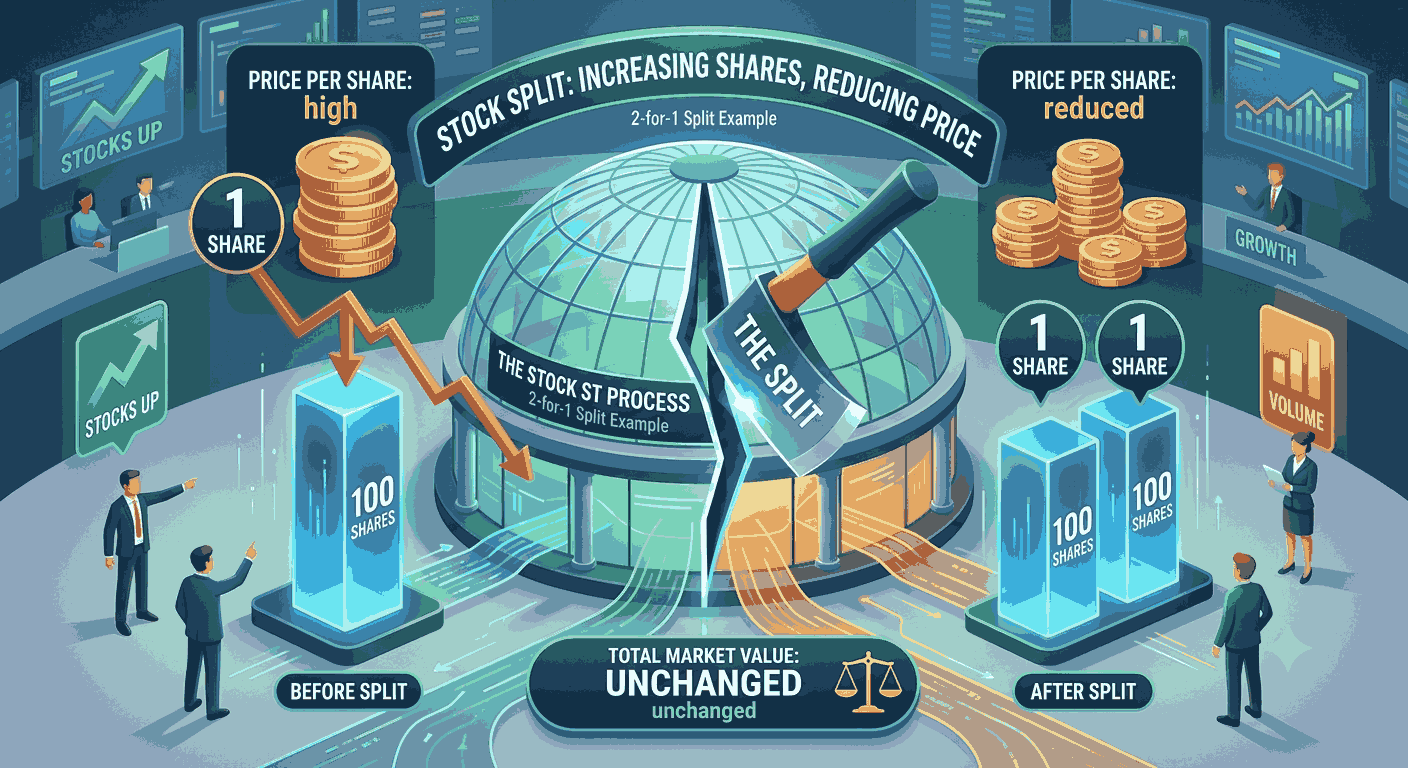
A stock split does not increase the company's profits, assets, revenue, or market value.
Only the number of shares and their individual price change.
For example:
Before Split:
After a 1:2 Split:
The company's overall valuation remains unchanged.
A stock split offers several benefits.
More investors can participate, leading to higher trading volumes.
Lower-priced shares often appear more accessible to retail investors.
A stock split is often announced after strong business growth, which can create positive investor sentiment.
More investors may enter the stock due to its lower price.
Although a stock split has several advantages, it also has a few limitations.
A stock split should never be considered a reason to invest without evaluating the company's fundamentals.
Many investors confuse stock splits with bonus shares, but they are different.
| Stock Split | Bonus Shares |
|---|---|
| Existing shares are divided into smaller units. | Additional shares are issued from the company's reserves. |
| Face value decreases. | Face value generally remains unchanged. |
| Number of shares increases. | Number of shares also increases. |
| Investment value remains the same immediately after the split. | Investment value also remains unchanged initially. |
A stock split itself is generally not considered a taxable event because you are not receiving any cash or additional value.
However, the purchase cost of each share is adjusted according to the split ratio. This adjusted cost is used while calculating capital gains when you eventually sell your shares.
A stock split alone should not be the reason to invest.
Before investing, consider factors such as:
A good business remains a good business whether its share price is ₹500 or ₹5,000.
A stock split is simply a way of dividing existing shares into smaller units without changing the overall value of your investment. It improves affordability, enhances liquidity, and can attract more investors, but it does not increase the intrinsic value of a company.
As an investor, it's important to understand that a stock split is an administrative change rather than a measure of business performance. Always evaluate a company's financial health and long-term growth potential before making any investment decisions.
A stock split is a corporate action where a company increases the number of its outstanding shares by proportionately reducing the share price and face value.
A stock split can improve liquidity and make shares more affordable, but it does not increase the value of your investment.
No. The total value of your investment remains the same immediately after the split.
Companies usually split shares to improve affordability, increase liquidity, and encourage greater participation from retail investors.
Your number of shares increases according to the split ratio, while the price per share decreases proportionately.
If a company pays dividends, the dividend per share may be adjusted after the split. However, the total dividend amount generally remains proportionate.
A stock split itself is generally not taxable, but the adjusted purchase price is considered when calculating capital gains upon sale.
A stock split should not be the only reason to invest. Beginners should evaluate the company's financial performance, valuation, and long-term growth prospects before investing.