
 Aug-03-2026
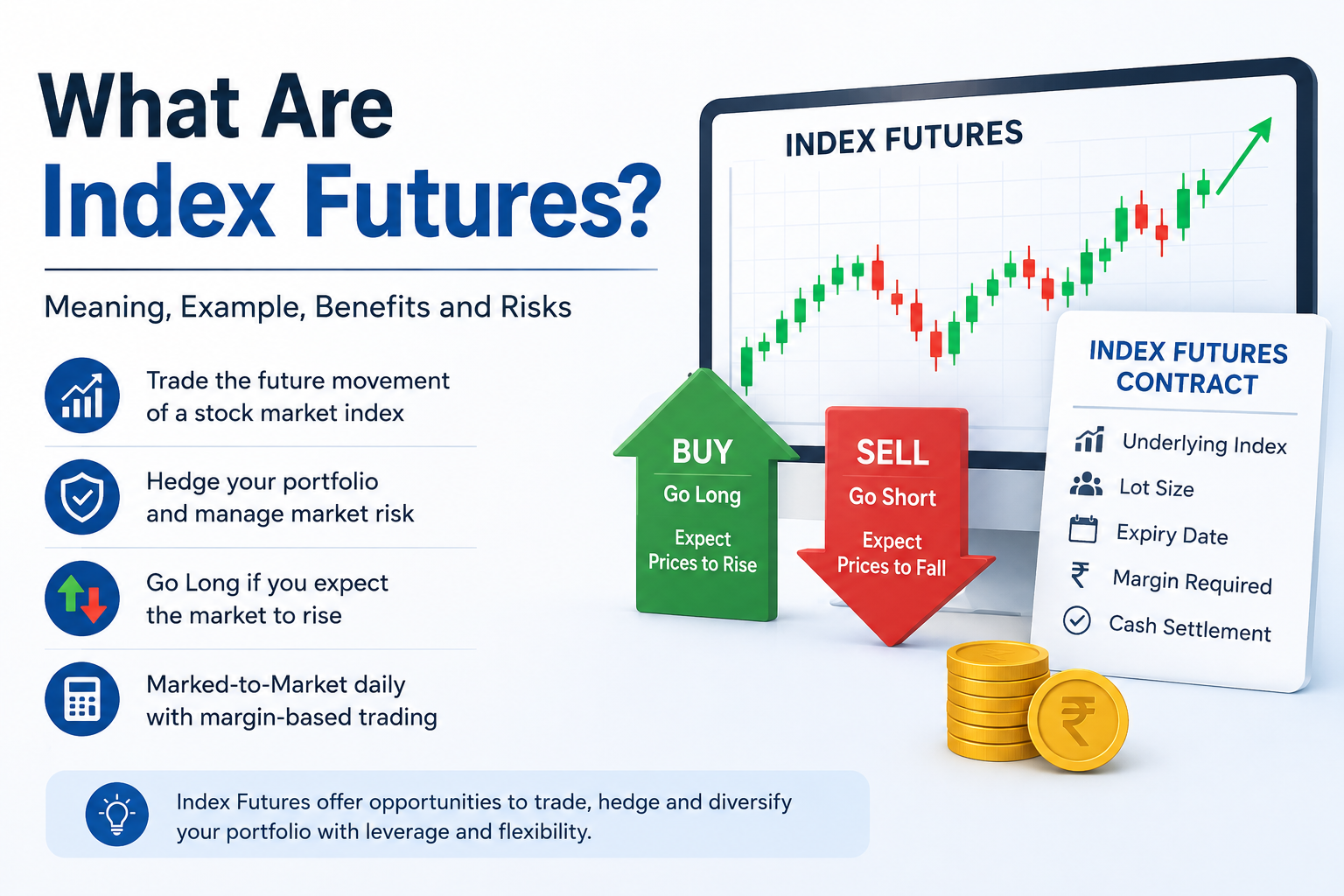
Index futures are derivative contracts that allow traders to take a position on the future movement of a stock market index.
Instead of buying or selling every stock included in an index, a trader can use a single futures contract to gain exposure to the broader market or a particular market segment.
For example, a Nifty 50 futures contract reflects expectations about the future value of the Nifty 50 index. Similarly, a banking index futures contract tracks the expected movement of the banking sector index.
Index futures are commonly used for three purposes:
Trading on the expected direction of the market
Protecting an equity portfolio from a possible decline
Managing short-term market exposure
These contracts can offer flexibility, but they also involve leverage. A relatively small market movement can therefore create a significant profit or loss.
A stock market index represents the performance of a selected group of listed companies.
The companies included in an index are generally selected according to factors such as market capitalisation, liquidity, trading activity and sector representation.
For example, a broad-market index may include companies from banking, technology, energy, consumer goods and other major sectors.
An index gives investors a quick view of how the overall market or a particular segment is performing.
However, an index itself cannot be bought or sold like a regular company share. Traders use instruments such as index funds, exchange-traded funds, index options and index futures to take exposure to its movement.
An index futures contract is an agreement to buy or sell the value of an underlying stock market index at a predetermined futures price on or before a specified expiry date.
The contract does not involve ownership of the shares included in the index.
It is based entirely on the movement of the index value.
A buyer of index futures expects the index to rise. A seller expects it to fall.
Because a stock market index cannot be physically delivered, index futures are generally settled in cash.
Suppose a market index is trading at 24,000.
A trader expects the market to rise and buys one futures contract at 24,050.
Later, the futures price rises to 24,250.
The trader closes the position and earns 200 index points.
The monetary profit depends on the applicable lot size:
Profit = Difference in futures price × Lot size
If the lot size were 50 units, the calculation would be:
200 × 50 = ₹10,000
Brokerage, statutory charges and applicable taxes would reduce the final profit.
Now assume that the futures price falls from 24,050 to 23,850.
The trader would lose 200 points:
200 × 50 = ₹10,000 loss
This example shows why futures trading can produce meaningful gains as well as substantial losses.
A trader goes long by buying an index futures contract.
This position may be taken when the trader expects the underlying index to rise.
If the futures price increases, the long trader may earn a profit. If it declines, the trader may incur a loss.
A trader goes short by selling an index futures contract.
This position may be taken when the trader expects the index to fall.
If the futures price declines, the short trader may profit. If the market rises, the short position may generate losses.
Unlike the cash market, futures allow traders to take a bearish position without first owning the underlying shares.
The exchange defines the contract specifications, including:
Underlying index
Lot size
Expiry date
Tick size
Settlement method
Traders cannot customise these terms.
Every futures contract has a defined expiry date.
Multiple monthly contracts may be available at the same time, commonly referred to as:
Near-month contract
Mid-month contract
Far-month contract
A trader does not pay the full contract value upfront.
Instead, the broker collects the required margin.
This creates leverage because the trader controls a larger contract value with a smaller amount of capital.
Futures positions are generally marked to market daily.
Profit or loss arising from the day’s price movement is credited to or debited from the trader’s account.
Index futures are settled in cash because an index cannot be physically delivered.
There is no transfer of all the individual shares forming the index.
Margin is the amount a trader must maintain to take and hold a futures position.
Consider an index futures contract with a total value of ₹12 lakh.
If the required margin is ₹1.5 lakh, the trader can control a ₹12 lakh position by depositing ₹1.5 lakh.
This leverage can improve capital efficiency, but it also magnifies risk.
A movement of only 1% in the contract value may create a much larger percentage gain or loss on the margin deployed.
The broker may require additional funds when losses reduce the available margin. If the required margin is not maintained, the broker may reduce or close the position.
Mark-to-market, commonly called MTM, is the daily settlement of profit and loss on an open futures position.
Suppose a trader buys index futures at 24,000 and the daily settlement price rises to 24,100.
The trader earns 100 points for that day.
If the lot size is 50, the MTM profit would be:
100 × 50 = ₹5,000
If the settlement price had fallen to 23,900, the trader would have faced an MTM loss of ₹5,000.
This process continues daily until the position is closed or the contract expires.
The spot price is the current value of the underlying index.
The futures price is the price at which its futures contract is trading.
The two prices may differ before expiry because of factors such as:
Interest rates
Dividend expectations
Time remaining to expiry
Market demand and supply
Trading sentiment
As the expiry date approaches, the futures price generally moves closer to the spot index value. This process is known as convergence.
A futures contract trades at a premium when its price is above the spot index.
For example:
Spot index: 24,000
Futures price: 24,120
The futures contract is trading at a premium of 120 points.
A futures contract trades at a discount when its price is below the spot index.
For example:
Spot index: 24,000
Futures price: 23,940
The futures contract is trading at a discount of 60 points.
A premium or discount should not be treated as a guaranteed forecast. It may reflect carrying costs, dividends, demand, hedging activity and short-term market positioning.
Index futures may be based on different categories of stock market indices.
These contracts track a diversified market index containing companies from several sectors.
They are used to take a view on the direction of the broader market.
These contracts track a banking-sector index.
Their prices may be influenced by interest rates, credit growth, asset quality, central-bank policy and financial-sector developments.
A sectoral index represents companies from a particular industry, such as technology or financial services.
These futures allow traders to take exposure to the movement of a specific sector rather than the entire market.
Some indices are created around a theme, investment strategy or group of companies sharing certain characteristics.
Availability depends on exchange approval and trading liquidity.
Directional traders use futures when they expect the market to rise or fall.
Investors may sell index futures to reduce the short-term market risk of an equity portfolio.
Mutual funds, foreign portfolio investors and other institutions may use index derivatives for hedging, cash management and portfolio rebalancing.
Arbitrage traders look for temporary differences between the spot index, index constituents and futures prices.
Suppose an investor holds a diversified equity portfolio worth ₹25 lakh.
The investor remains positive about the portfolio for the long term but expects the overall market to decline over the next few weeks.
Instead of selling all the shares, the investor may sell index futures.
If the market falls:
The equity portfolio may lose value.
The short futures position may generate a profit.
The futures profit can partly offset the portfolio loss.
However, the hedge may not be perfect. The portfolio may not move exactly in line with the selected index.
This difference is known as basis risk.
Assume an investor holds a diversified portfolio worth ₹20 lakh.
The portfolio has historically moved broadly in line with a major market index.
The investor sells index futures with a similar exposure.
If the market falls by 5%:
Approximate portfolio loss: ₹1 lakh
Approximate futures gain: ₹1 lakh
The hedge may reduce the net impact of the decline.
However, if the market rises, the portfolio may gain while the short futures position loses money. Hedging reduces downside risk but can also limit the benefit of a market rally.
| Basis | Index Futures | Stock Futures |
|---|---|---|
| Underlying | Stock market index | Individual company share |
| Company-specific risk | Lower | Higher |
| Diversification | Built into the index | Exposure limited to one company |
| Physical delivery | Generally cash-settled | Settlement depends on applicable market rules |
| Main use | Market exposure and portfolio hedging | Company-specific trading or hedging |
| Price drivers | Broader market and economic factors | Company news and sector developments |
| Basis | Index Futures | Index Options |
|---|---|---|
| Obligation | Both parties have an obligation | Buyer has a right, not an obligation |
| Upfront payment | Margin required | Buyer pays premium |
| Buyer’s maximum loss | Can be substantial | Generally limited to premium paid |
| Profit and loss | Moves with futures price | Depends on strike, premium, expiry and volatility |
| Time-value impact | Less direct | Significant |
| Settlement | Cash-settled | Cash-settled |
Futures are linear instruments. A one-point movement generally creates a corresponding one-point gain or loss multiplied by the lot size.
Options have a different payoff structure and are influenced by several additional variables.
A single contract provides exposure to an entire index rather than one company.
Poor performance by one constituent may be offset by stronger performance from another company in the index.
Investors can use short futures positions to protect portfolios against market declines.
Traders can take long positions in rising markets and short positions in falling markets.
Only the required margin must be deposited instead of the full contract value.
Contracts are standardised and traded through regulated exchanges.
A small market movement can produce a large percentage loss on the margin amount.
A trader may need to provide additional funds when the position moves adversely.
Unexpected economic news, global events or policy decisions can cause sudden index movements.
A futures hedge may not move exactly in line with the portfolio being protected.
Some contracts may have lower trading activity and wider bid-ask spreads.
A trader who wants to continue a position beyond expiry must close the existing contract and enter a later-month contract. The price difference can affect the outcome.
The availability of leverage may encourage traders to take positions larger than their capital can safely support.
Futures contracts expire after a fixed period.
A trader who wants to continue the position must:
Close the expiring contract.
Open a similar position in a later-expiry contract.
This process is called rollover.
The next-month contract may trade at a different price. The difference between the two contracts is known as the rollover spread.
Rollover data is sometimes used to assess market positioning, but it should not be considered a standalone trading signal.
Index futures may react to:
Movement in the underlying index
Interest-rate expectations
Expected dividends
Corporate earnings
Inflation data
Central-bank decisions
Government policy
Foreign investor activity
Currency movements
Global market trends
Geopolitical events
Time remaining to expiry
Because index futures respond quickly to new information, prices can become volatile around major announcements.
A trader generally needs:
An active trading and demat relationship with a registered broker
Derivatives-segment activation
Sufficient margin
Understanding of lot size and contract value
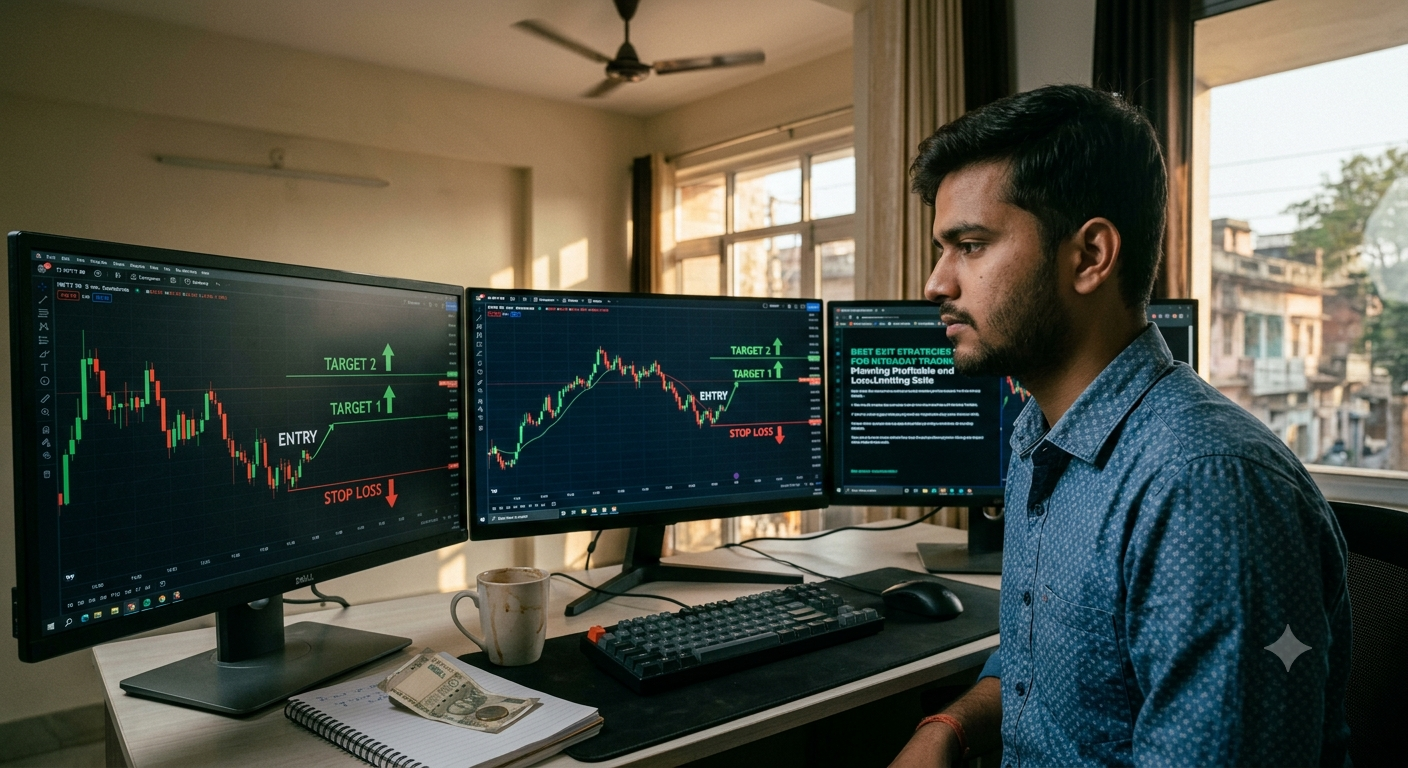
A defined entry, stop-loss and exit plan
A typical process includes:
Select the underlying index.
Choose the expiry month.
Review the futures price, volume and open interest.
Check the margin requirement.
Decide whether to buy or sell.
Set a risk limit.
Monitor MTM obligations.
Close or roll over the position before expiry when required.
Do not assess risk only on the margin paid.
Always calculate:
Futures price × Lot size
This represents the effective contract exposure.
A trader should avoid committing most of the available capital to a single position.
Decide the acceptable loss before placing the trade.
Keeping only the minimum margin may lead to forced closure during volatile market movements.
Adding to a losing leveraged position can increase risk rapidly.
Policy announcements, election results, global market developments and economic data can create large price gaps.
Index futures can open sharply higher or lower following global events occurring after domestic market hours.
Index futures are simple to understand at a basic level, but managing them is not always easy.
Their leveraged structure means losses can accumulate quickly.
Before trading index futures, a beginner should understand:
Contract value
Lot size
Margin
Mark-to-market settlement
Expiry
Rollover
Stop-loss execution
Gap risk
Brokerage and statutory charges
Paper trading and detailed contract-level calculations can help build familiarity, but they do not fully reproduce the emotional and execution risks of real-money trading.
Index futures offer an efficient way to trade the direction of the broader market, hedge an equity portfolio and manage market exposure.
Their key advantage is that one contract can provide exposure to an entire basket of stocks. However, the same leverage that improves capital efficiency can also magnify losses.
Index futures should therefore be used with a clear understanding of contract value, margin obligations, daily settlement and expiry rules.
A disciplined trading plan, adequate capital buffer and strict position sizing are essential. Futures trading should be approached as a risk-management exercise rather than a shortcut to quick returns.
Index futures are standardised derivative contracts whose value is based on an underlying stock market index.
A stock market index itself cannot be bought like a share. Exposure can be taken through instruments such as index funds, ETFs, index futures and index options.
Profit or loss is generally calculated by multiplying the change in futures price by the applicable lot size.
Index futures are generally cash-settled because a stock market index cannot be physically delivered.
Margin is the amount required by the broker and clearing system to initiate and maintain a futures position.
Yes. Traders can sell index futures without owning the shares included in the underlying index.
Mark-to-market is the daily settlement of profit or loss arising from changes in the futures price.
Index futures are based on a basket of shares represented by an index, whereas stock futures are based on an individual company’s shares.
Yes. Investors may sell index futures to reduce the short-term market risk of a diversified equity portfolio.
The contract is settled according to the applicable final settlement price. Traders can also close or roll over their position before expiry.
Yes. Margin is only a security deposit and not the maximum possible loss. Adverse price movements can create losses greater than the initial margin.
Index futures are regulated exchange-traded instruments, but they involve market, leverage, margin and liquidity risks. Their suitability depends on the trader’s knowledge, capital and risk capacity.