
 Aug-10-2026
What is Value at Risk (VaR)? Every investment carries some level of risk, but understanding how much you could potentially lose is just as important as estimating how much you might gain. This is where Value at Risk (VaR) comes into the picture.
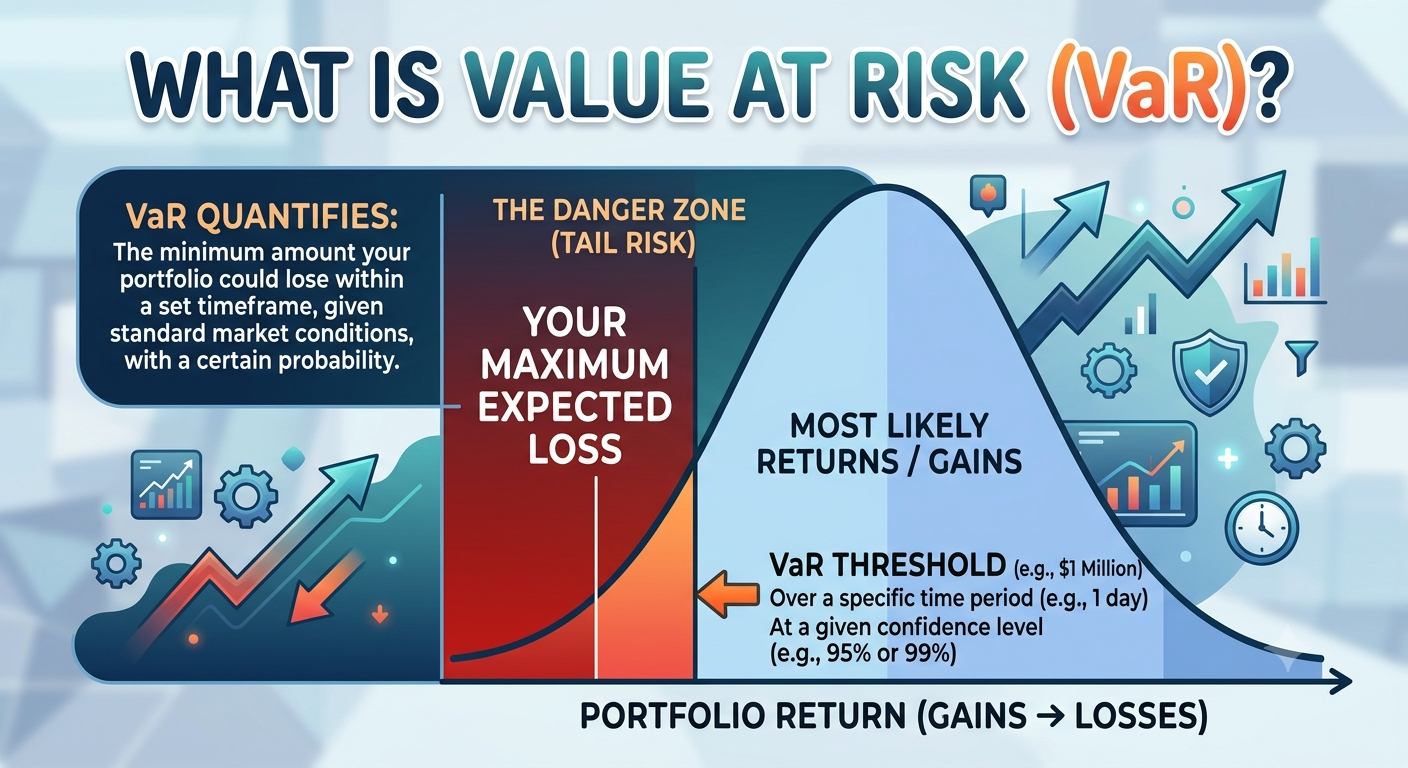
Value at Risk, commonly known as VaR, is a widely used risk measurement tool that estimates the maximum potential loss an investment or portfolio could face over a specific period under normal market conditions and at a given confidence level.
Banks, mutual funds, portfolio managers, insurance companies, and institutional investors use VaR to evaluate market risk and make informed investment decisions. While it cannot predict future market movements with certainty, VaR provides a structured way to assess downside risk.
What Does Value at Risk Mean? Value at Risk is a statistical measure that answers a simple question:
"How much could I lose over a given period with a certain level of confidence?"
For example, if a portfolio has a one-day VaR of ₹2 lakh at a 95% confidence level, it means there is a 95% probability that the portfolio will not lose more than ₹2 lakh in a single trading day under normal market conditions.
It also implies that there is a 5% chance the loss could exceed ₹2 lakh.
Why is VaR Important? Financial markets are unpredictable, and sudden price movements can significantly impact investment portfolios.
VaR helps investors and institutions:
Measure market risk
Estimate potential losses
Set risk limits
Allocate capital efficiently
Compare the risk of different portfolios
Support investment decisions
Rather than relying solely on intuition, VaR provides a quantitative approach to risk management.
Components of Value at Risk Three key elements define a VaR calculation.
Examples include:
One day
Ten days
One month
One year
Short-term traders typically use daily VaR, while long-term investors may analyse monthly or annual VaR.
Common confidence levels include:
90%
95%
99%
A higher confidence level generally results in a larger VaR estimate.
Example of Value at Risk Suppose an investor has a portfolio worth ₹25 lakh.
After analysing historical market data, the portfolio's one-day VaR at a 95% confidence level is calculated as ₹60,000.
This means there is a 95% probability that the portfolio will not lose more than ₹60,000 in one trading day under normal market conditions.
However, extraordinary market events may still result in losses exceeding this amount.
How is Value at Risk Calculated? There are several methods for calculating VaR, each with its own assumptions and applications.
It assumes that past market behaviour provides useful insights into future price movements.
Advantages Simple to understand
Uses actual historical data
No assumption of normal distribution
Limitations Relies heavily on past market behaviour
May not capture unprecedented events
It estimates VaR using:
Average returns
Standard deviation
Correlation among assets
Advantages Quick to calculate
Suitable for large portfolios
Limitations Assumes normal market behaviour
Less effective during extreme volatility
It estimates potential portfolio losses under various simulated conditions.
Advantages Highly flexible
Suitable for complex portfolios
Captures multiple market variables
Limitations Computationally intensive
Requires sophisticated modelling
Formula for Parametric VaR A commonly used formula for Parametric VaR is:
VaR = Portfolio Value × Z-score × Standard Deviation
Where:
Portfolio Value = Total value of investments
Z-score = Based on the chosen confidence level
Standard Deviation = Measure of portfolio volatility
The formula provides an estimate of potential losses under normal market conditions.
Factors Affecting VaR Several factors influence the Value at Risk of a portfolio.
Market Volatility Higher volatility generally increases VaR.
Portfolio Size Larger portfolios usually have higher absolute VaR values.
Asset Diversification Diversification may reduce overall portfolio risk and lower VaR.
Correlation Between Assets Assets that move differently from one another can reduce portfolio risk.
Investment Horizon Longer holding periods may result in larger VaR estimates.
Advantages of Value at Risk Easy to Interpret VaR expresses risk in monetary terms, making it easier to understand.
Supports Risk Management Financial institutions use VaR to establish risk limits and monitor portfolio exposure.
Facilitates Portfolio Comparison Investors can compare the risk levels of different portfolios using a common measure.
Widely Accepted VaR is used globally by banks, asset management companies, hedge funds, and regulators.
Limitations of Value at Risk Despite its popularity, VaR has several limitations.
Does Not Predict Extreme Events VaR estimates losses under normal market conditions and may underestimate losses during financial crises.
Depends on Assumptions Some VaR models rely on assumptions regarding return distributions and historical relationships.
Ignores Tail Risk VaR indicates the threshold of potential losses but does not estimate how large losses could become beyond that threshold.
Model Risk Different calculation methods may produce different VaR estimates for the same portfolio.
Value at Risk vs Expected Shortfall Value at Risk (VaR) Expected Shortfall (ES) Estimates the maximum expected loss at a chosen confidence level Estimates the average loss if the VaR threshold is exceeded Focuses on a loss threshold Focuses on losses beyond the threshold Easier to calculate Provides a more comprehensive view of extreme risk Widely used in financial institutions Increasingly used in advanced risk management Applications of Value at Risk VaR is widely used across the financial industry.
Banks To monitor trading risk and maintain regulatory capital.
Asset Management Companies To evaluate portfolio risk and optimise asset allocation.
Insurance Companies To assess investment portfolio exposure.
Corporate Treasury Departments To manage currency, interest rate, and commodity price risk.
Individual Investors To understand the downside risk of investment portfolios.
Tips for Using VaR Effectively To improve the usefulness of VaR:
Combine it with stress testing.
Review portfolio risk regularly.
Diversify investments across asset classes.
Consider liquidity risk.
Do not rely on VaR alone when making investment decisions.
A combination of multiple risk measures provides a more complete understanding of portfolio risk.
Final Thoughts Value at Risk (VaR) is one of the most widely used tools for measuring market risk. It provides investors and financial institutions with an estimate of potential losses under normal market conditions, helping them make informed decisions and establish appropriate risk limits.
However, VaR should not be viewed as a guarantee against losses. Market conditions can change rapidly, and unexpected events may result in losses beyond the estimated VaR. For this reason, investors should use VaR alongside other risk management techniques, such as stress testing, scenario analysis, and diversification, to build more resilient investment portfolios.
Frequently Asked Questions (FAQs) What is Value at Risk (VaR)? Value at Risk (VaR) is a statistical measure used to estimate the maximum potential loss an investment or portfolio could experience over a specified period at a given confidence level.
Why is VaR important? VaR helps investors measure downside risk, manage portfolio exposure, and make more informed investment decisions.
How is VaR calculated? VaR can be calculated using historical simulation, the variance-covariance method, or Monte Carlo simulation.
What is a 95% VaR? A 95% VaR means there is a 95% probability that losses will not exceed the estimated amount during the specified period under normal market conditions.
Does VaR predict future losses? No. VaR estimates potential losses based on statistical models and historical data but cannot predict future market movements with certainty.
What are the limitations of VaR? VaR may underestimate losses during extreme market events and depends on the assumptions used in the chosen calculation method.
Who uses Value at Risk? Banks, mutual funds, portfolio managers, insurance companies, regulators, and individual investors use VaR as part of their risk management process.
Is VaR enough to manage investment risk? No. VaR is most effective when combined with stress testing, diversification, and other risk management techniques.
Suggested SEO Keywords Value at Risk
What is VaR
Value at Risk meaning
VaR formula
VaR calculation
Types of Value at Risk
Market risk management
Portfolio risk measurement
Financial risk analysis
VaR in investing
FAQ Schema Questions What is Value at Risk (VaR)?
How is Value at Risk calculated?
Why is VaR important in investing?
What does a 95% VaR mean?
What are the different methods of calculating VaR?
What are the limitations of Value at Risk?
Who uses Value at Risk?
What is the difference between VaR and Expected Shortfall?