
 Oct-05-2026
When you sell shares, close a trading position or have unused money in your trading account, you may eventually want to transfer the available funds back to your bank account.
The process of transferring eligible money from your trading account to your registered bank account is commonly known as a funds payout or fund withdrawal.
At first glance, this sounds straightforward. If your trading account shows ₹1,00,000, you may expect to be able to withdraw the entire ₹1,00,000 immediately.
That is not always the case.
Your trading account may display different types of balances, and some funds may still be under settlement, blocked for margin requirements or required for charges and open positions.
Understanding the difference between total balance, available trading balance, unsettled balance and withdrawable balance can help avoid confusion when requesting a payout.
Funds payout refers to the transfer of eligible funds from a trading account to a bank account registered with the broker.
For example, suppose your withdrawable balance is:
₹75,000
You submit a withdrawal request for:
₹40,000
After the request is successfully processed, ₹40,000 is transferred to your registered bank account, subject to the broker's payout process and banking timelines.
The remaining eligible balance stays in your trading account.
These two terms are often confused.
Funds pay-in generally refers to adding or providing money toward your trading or settlement obligations.
For a retail investor, this can include transferring money from a bank account to the trading account for purchasing securities or meeting applicable obligations.
Funds payout is the movement in the opposite direction—the eligible amount is transferred from the trading ecosystem back to the registered bank account.
In simple terms:
Pay-In → Money moves towards meeting trading/settlement obligations
Payout → Eligible money moves back towards the investor
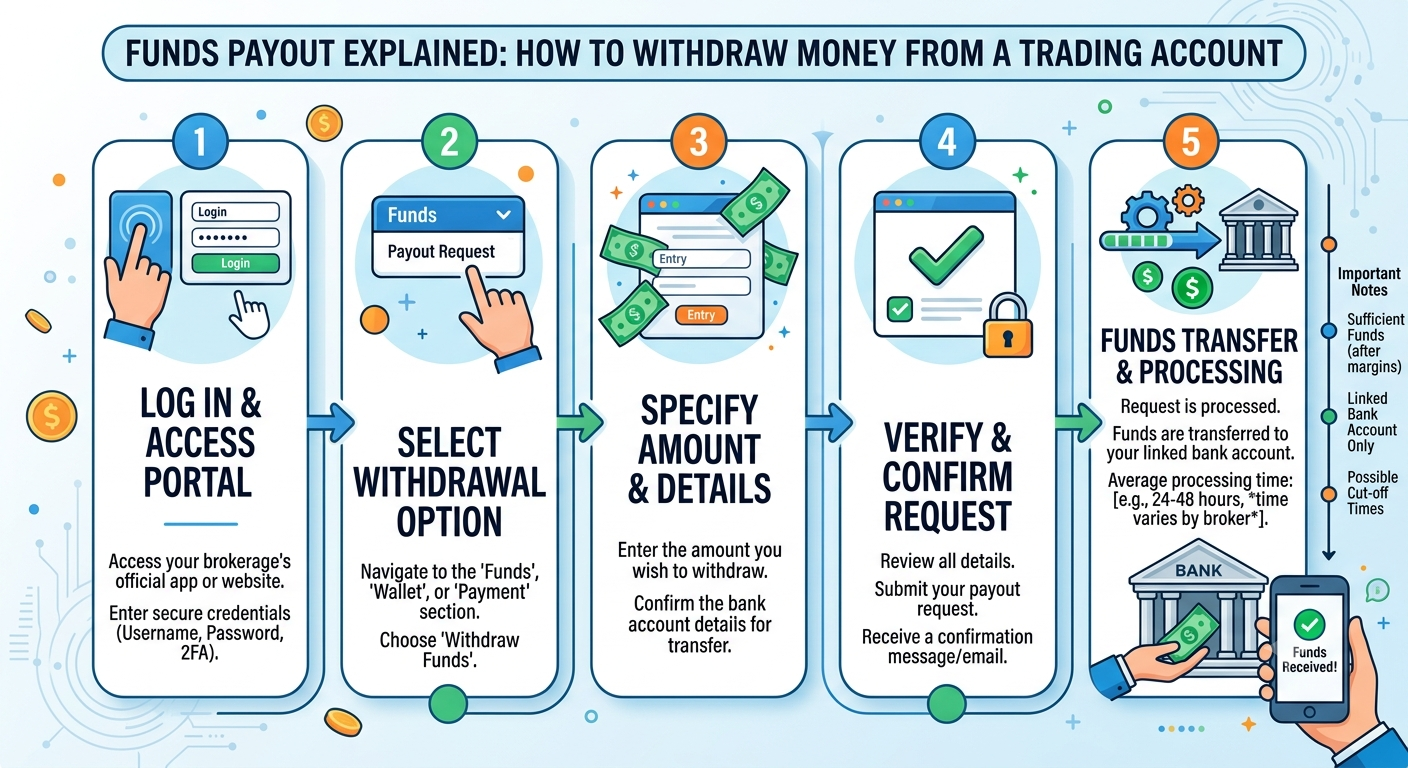
A typical withdrawal process involves the following stages:
The investor checks the withdrawable balance.
A withdrawal request is submitted through the broker's platform.
The broker checks available funds, unsettled obligations, margins and applicable charges.
The eligible payout amount is determined.
The request is processed according to the broker's payout cycle.
Funds are transferred to the registered bank account.
The exact cut-off times and processing schedules can differ among brokers.
Withdrawable balance is the amount currently eligible to be transferred from your trading account to your registered bank account.
Suppose your trading platform shows:
Total funds: ₹1,00,000
Unsettled amount: ₹30,000
Margin blocked: ₹20,000
Eligible withdrawable amount: ₹50,000
Although the account displays ₹1 lakh in total, you may currently be able to withdraw only ₹50,000.
This is why investors should check the withdrawable balance, rather than relying only on the total funds displayed.
Unsettled balance generally refers to money arising from transactions whose exchange settlement process has not yet been completed.
Suppose you sell delivery shares worth ₹80,000 today.
The transaction has taken place, and your trading platform may reflect the sale proceeds.
However, the amount may not immediately become fully withdrawable because the trade still has to complete the applicable settlement cycle.
Once settlement requirements are completed, the eligible amount can move into the withdrawable balance.
These two numbers can be different.
Available trading balance may represent funds that can be used for certain trading purposes.
Withdrawable balance represents funds currently eligible for transfer to the registered bank account.
For example:
| Particulars | Amount |
|---|---|
| Trading balance displayed | ₹1,20,000 |
| Unsettled sale proceeds | ₹40,000 |
| Amount blocked for margin | ₹20,000 |
| Illustrative withdrawable balance | ₹60,000 |
This is a simplified example. Actual balances depend on transactions, margins, settlement status, charges and broker systems.
In the Indian equity market, T refers to the trading day.
Under a T+1 settlement cycle, an eligible trade executed on T is settled on the next applicable working settlement day.
For example:
Suppose you sell shares on Monday.
Monday = T
Tuesday = T+1, assuming Tuesday is an applicable settlement working day.
The trade is therefore settled on Tuesday under the normal T+1 cycle.
Weekends, exchange holidays and relevant settlement holidays can affect the timeline.
Suppose you own 100 shares of a company.
You sell them on Monday at ₹500 each.
Sale value:
100 × ₹500 = ₹50,000
The sale proceeds may appear in your trading account after the transaction.
However, this does not necessarily mean the entire ₹50,000 is immediately withdrawable on Monday.
Under the applicable settlement process, the eligible funds generally become withdrawable after settlement and subject to the broker's payout cycle, outstanding obligations and charges.
Generally, sale proceeds that remain unsettled cannot simply be treated as settled withdrawable funds on the trade date.
The distinction is important:
Visible in trading account ≠ necessarily withdrawable immediately
The funds may become eligible for withdrawal after the applicable settlement process is completed.
Investors should therefore check the withdrawable balance displayed by their broker.
Suppose you sell shares on Friday under a normal T+1 settlement.
The next calendar day is Saturday, but Saturday is normally not a settlement working day.
Sunday is also excluded.
Subject to the exchange and banking holiday calendar, settlement would ordinarily move to the next applicable working settlement day.
Therefore, investors should understand that T+1 means the next applicable settlement working day, not necessarily the next calendar day.
Yes.
Settlement and payout timelines can be affected by:
Saturdays
Sundays
Exchange holidays
Clearing holidays
Banking holidays where relevant
Suppose Monday is the expected settlement day but is a settlement holiday.
The applicable process can move to the next eligible working settlement day.
This is particularly important around long weekends and major festivals.
This is one of the most common questions among investors.
Several factors can cause the difference.
Recent sale proceeds may not yet have completed settlement.
Part of the balance may be required to support existing positions.
Funds may be blocked to meet applicable margin obligations.
Applicable brokerage, taxes and statutory charges can reduce the final available amount.
Other settlement obligations can affect the amount eligible for withdrawal.
Therefore:
Trading balance and withdrawable balance should not automatically be treated as the same amount.
Suppose your withdrawable balance appears to be ₹1,00,000 and you request the full amount.
Before the payout is processed, you enter another trade.
Assume that trade uses ₹20,000 of the funds.
The amount actually available at processing may now be only ₹80,000.
Consequently, you may receive a partial payout.
Other reasons can include:
Changed margin requirements
Trading losses
Brokerage
Statutory charges
New positions
Pending obligations
The final payout depends on the eligible clear balance when the request is processed.
A withdrawal request may fail or be rejected for several reasons.
Common possibilities include:
Insufficient withdrawable balance
New trades placed after the request
Increased margin requirement
Outstanding debit balance
Pending settlement
Incorrect or inactive bank details
Banking issues
Account-related restrictions
Technical or operational issues
The exact reason should normally be visible through the broker's platform or communicated by the broker.
This depends on the broker's systems and whether the payout request has already been processed or funds have been blocked.
In some systems, placing a request does not necessarily mean the amount is immediately removed from the usable balance.
If the investor subsequently uses part of the balance for another transaction, the amount available for withdrawal can change.
For example:
Balance before request = ₹50,000
Withdrawal requested = ₹50,000
New trade uses = ₹15,000
Remaining eligible amount may then be lower than the original ₹50,000 request, depending on the broker's processing rules.
Investors should therefore avoid assuming that requested funds are already transferred until the payout is processed.
Profits and funds arising from Futures & Options transactions are subject to the applicable settlement framework.
For example, mark-to-market profits or amounts released after closing positions may be reflected in the trading account before becoming eligible for bank withdrawal.
The investor should check the broker's withdrawable balance rather than assuming that every amount visible in the account can immediately be transferred.
Suppose an intraday trader starts with ₹1,00,000.
During the day, the trader earns an illustrative profit of ₹5,000.
The platform may show a total balance reflecting the day's activity.
However, the ₹5,000 profit may be subject to the applicable settlement process before it becomes withdrawable.
Similarly, if the trader incurs losses or charges after submitting a withdrawal request, the final eligible payout can be lower.
Trading involves various applicable costs.
Depending on the transaction, these can include:
Brokerage
Securities Transaction Tax (STT)
Exchange transaction charges
GST
Stamp duty
SEBI-related charges
Depository charges where applicable
These costs can affect the final ledger and withdrawable balance.
Suppose:
Gross sale proceeds = ₹1,00,000
Applicable charges = ₹500
Ignoring other obligations, the net amount would not be the full ₹1 lakh.
Investors should therefore evaluate the net ledger position rather than only the gross transaction value.
Funds are generally transferred only to a bank account registered and verified with the trading account.
This is an important investor-protection mechanism.
Where a broker permits multiple registered bank accounts, the available selection process depends on the broker's platform and policies.
Investors should keep the following details updated:
Bank account number
IFSC
Account status
Registered name
Other required banking information
Incorrect or outdated banking details can delay or disrupt payouts.
There is no single broker-level payout time that applies universally to every trading platform.
The actual time can depend on:
When the withdrawal request is submitted
Broker payout cut-off
Settlement status
Available withdrawable balance
Bank processing
Clearing or banking holidays
Account verification
Operational conditions
Some brokers may process payouts multiple times during a working day, while others may follow different schedules.
Investors should check their broker's current payout policy for exact timings.
Regular payout processing may not operate in the same manner on weekends because exchange settlement and banking processes are linked to working-day calendars.
A request submitted late on Friday or during the weekend may therefore be processed on the next eligible working day according to the broker's policy.
Exchange, clearing and bank holiday calendars should also be considered.
The word "payout" is used in both contexts, but they refer to different assets.
This relates to securities being delivered as part of the settlement process.
For example, when an investor purchases shares for delivery, securities are credited according to the applicable settlement mechanism.
This relates to money being released or transferred following settlement and, at the client level, withdrawal of eligible money to the registered bank account.
The two are connected through the clearing and settlement process but should not be treated as identical.
This distinction is particularly important.
Settlement is the exchange and clearing process through which trade obligations are completed.
Withdrawal is the client's request to transfer eligible money from the trading account to the registered bank account.
A trade can therefore first complete settlement, after which the eligible balance becomes available for withdrawal according to the broker's process.
Suppose an investor sells shares worth ₹1,50,000 on Monday.
Shares are sold.
Sale proceeds may appear in the account but can remain unsettled.
Assuming Tuesday is an applicable settlement working day, the normal settlement process is completed.
Subject to other obligations and charges, eligible funds can become withdrawable.
The investor requests ₹1,00,000.
The broker checks:
Clear balance
Margin requirements
Pending transactions
Charges
Registered bank details
If everything is in order, the eligible amount is processed according to the broker's payout schedule.
Alongside T+1 settlement, the Indian equity market also has a T+0 settlement mechanism for eligible trades/securities under the applicable framework.
T+0 means settlement takes place on the trade day itself rather than on the next settlement day.
However, investors should not assume that every equity transaction automatically follows T+0.
The applicable settlement cycle depends on the segment, security, trade and prevailing exchange framework.
A payout may take longer than expected because of:
Unsettled transactions
Holiday schedules
Insufficient clear balance
Margin requirements
New trades
Open positions
Bank account issues
Broker processing cut-offs
Banking delays
Compliance restrictions
Technical issues
Checking the withdrawal status and ledger can usually help identify the cause.
Before placing a withdrawal request, check:
Current withdrawable balance
Recent unsettled transactions
Open positions
Margin requirements
Pending orders
Ledger balance
Applicable charges
Registered bank details
Broker's payout cut-off
Upcoming settlement or banking holidays
These checks can reduce the likelihood of a partial or rejected payout.
Not necessarily. Some amount may be unsettled or blocked.
The sale must follow the applicable settlement process before the amount becomes eligible for withdrawal.
Not necessarily. T+1 refers to the next applicable settlement working day.
Depending on the broker's system and subsequent activity, new trades, losses, margins or charges may affect the eligible amount before processing.
They are related but different processes.
Before submitting your request, ask:
Is the amount shown as withdrawable?
Have recent sale transactions settled?
Do I have open positions?
Is any amount blocked for margin?
Are there pending charges?
Is my bank account active and correctly registered?
Is today a settlement working day?
Have I checked the broker's payout cut-off?
Am I planning any new trades before the payout is processed?
Have I checked the withdrawal status after submitting the request?
Funds payout is the process through which eligible money is transferred from a trading account to a registered bank account.
The most important concept to understand is that the total balance displayed in a trading account may not be the same as the amount immediately available for withdrawal.
Recent transactions can remain unsettled, funds can be blocked against margin requirements and applicable charges or open positions can reduce the amount available for payout.
The settlement cycle also matters. In the normal T+1 framework, eligible trades are settled on the next applicable settlement working day rather than simply the next calendar day.
Before requesting a withdrawal, investors should check the withdrawable balance, settlement status, open positions, applicable margins and registered bank details.
Understanding these basic mechanics can make the trading-account withdrawal process much easier to manage.
Funds payout refers to transferring eligible money from a trading account to the investor's registered bank account.
Withdrawable balance is the amount currently eligible to be transferred from the trading account to the registered bank account.
Unsettled balance generally represents money arising from transactions that have not yet completed the applicable settlement process.
T+1 means that an eligible trade executed on trading day T is settled on the next applicable working settlement day.
Sale proceeds may need to complete the applicable settlement process before becoming eligible for withdrawal.
The difference may result from unsettled trades, margin requirements, open positions, charges or other outstanding obligations.
The eligible balance may have changed because of new trades, losses, margin requirements, charges or other obligations before processing.
Yes. A request can fail because of insufficient withdrawable balance, settlement issues, margin requirements, banking details or other operational reasons.
Settlement-day calculations exclude non-working settlement days such as weekends and applicable holidays.
Amounts arising from F&O transactions are subject to the applicable settlement framework and may not be immediately withdrawable merely because they appear in the trading account.
Settlement completes exchange-related trade obligations, while funds payout or withdrawal transfers eligible money from the trading account to the registered bank account.
T+0 refers to eligible transactions that are settled on the trade day itself under the applicable exchange framework.
What is funds payout in a trading account?
How do I withdraw money from a trading account?
What is withdrawable balance in a trading account?
What is unsettled balance in the stock market?
What does T+1 settlement mean?
When can I withdraw money after selling shares?
Why is my withdrawable balance lower than my total balance?
Why can a funds payout request be rejected?
What is the difference between funds payout and settlement?
Does T+1 settlement include weekends and holidays?