
 Jun-01-2026
Commodity trading has become an important part of portfolio diversification for Indian investors. Among the various commodity exchanges operating in India, the two most recognized names are National Commodity & Derivatives Exchange and Multi Commodity Exchange of India.
While both exchanges facilitate commodity trading, they cater to different market segments and serve distinct purposes. Understanding the difference between NCDEX and MCX can help traders choose the right platform based on their investment objectives, risk appetite, and market expertise.
This guide explores NCDEX vs MCX, their features, advantages, product offerings, and how traders can decide which exchange aligns with their trading strategy.
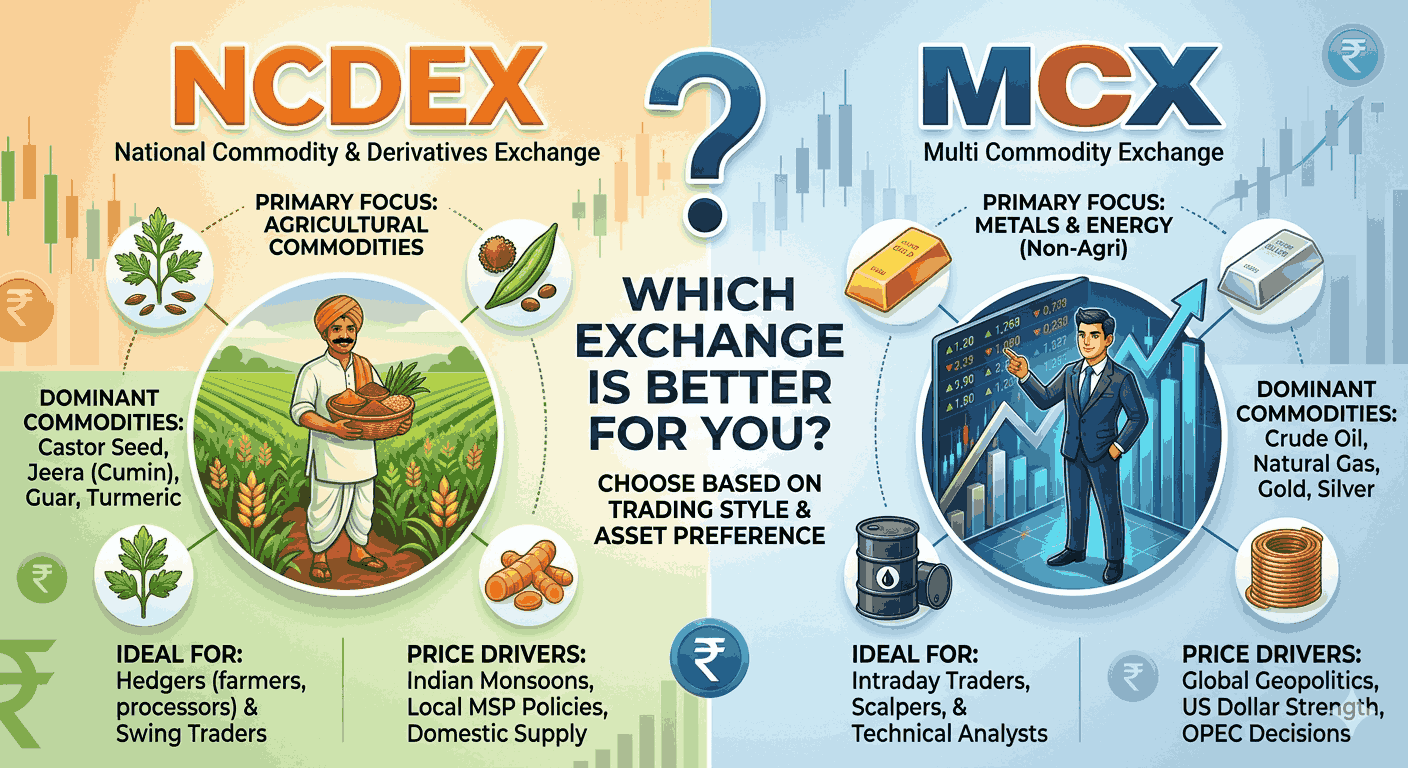
The National Commodity & Derivatives Exchange is a commodity exchange primarily focused on agricultural commodities.
Established in 2003, NCDEX provides a transparent electronic trading platform for farmers, traders, exporters, processors, and investors involved in agricultural products.
Popular commodities traded on NCDEX include:
The exchange plays a crucial role in price discovery and risk management within India's agricultural ecosystem.
The Multi Commodity Exchange of India is India's largest commodity derivatives exchange by trading volume.
MCX primarily facilitates trading in:
MCX is particularly popular among retail traders and institutional participants due to its high liquidity and wider product range.
| Feature | NCDEX | MCX |
|---|---|---|
| Primary Focus | Agricultural Commodities | Metals & Energy Commodities |
| Liquidity | Moderate | High |
| Trading Volume | Lower | Significantly Higher |
| Popular Traders | Farmers, Agribusinesses | Retail, HNIs, Institutions |
| Commodity Range | Agri-focused | Diverse Product Basket |
| Price Drivers | Weather, Crop Output, Demand | Global Markets, Geopolitics |
| Volatility | Moderate | High |
| International Correlation | Low | High |
NCDEX mainly focuses on commodities linked to India's agricultural economy.
Agricultural commodity prices are largely influenced by:
MCX offers exposure to both domestic and international commodity trends.
Price movements in MCX commodities are heavily influenced by:
Liquidity is one of the most important factors in commodity trading.
MCX generally offers:
NCDEX contracts may experience:
For active traders and scalpers, MCX often provides a more liquid trading environment.
Both exchanges operate during commodity market hours, but MCX contracts linked to international commodities may trade for extended periods.
Extended trading hours make MCX attractive for traders tracking global commodity markets.
Agricultural prices depend on:
Metal and energy prices depend on:
Investors can participate in India's agricultural growth story.
Prices are more influenced by domestic fundamentals.
Useful for:
Crop cycles often create predictable trading patterns.
Large participation results in smoother trade execution.
Access to:
Traders can benefit from international commodity trends.
Higher volatility can create more trading setups.
The answer depends on the trader's interests and expertise.
Many experienced traders eventually use both exchanges to diversify commodity exposure.
Before trading on either exchange, investors should understand the risks:
Risk management tools such as stop-loss orders and position sizing are essential.
Yes. MCX is India's largest commodity derivatives exchange in terms of trading volume and participation.
Yes. Retail investors can trade agricultural commodity futures available on NCDEX through registered brokers.
Gold and Silver futures are primarily traded on MCX.
NCDEX mainly specializes in agricultural commodity derivatives.
Commodity trading can be profitable, but returns depend on market knowledge, risk management, and trading discipline.
Yes. Most commodity brokers provide access to both exchanges through a single trading account.
When comparing NCDEX vs MCX, neither exchange is universally better. The right choice depends on the commodities you want to trade and your market expertise.
NCDEX is ideal for traders interested in agricultural commodities and domestic market dynamics. MCX is better suited for traders seeking high liquidity, global exposure, and opportunities in metals and energy markets.
For a balanced commodity trading strategy, many investors combine both exchanges to gain diversified exposure across agricultural, precious metal, industrial metal, and energy sectors.